 Will the second meeting of the Kiko’s House Book Club come to order.
(Sound of gavel being hammered.) Thank you.
We have for your perusing pleasure today a selection of six books recommended by visitors to Kiko’s House and yours truly. The books marked with an asterisk (*) are available in paperback.
While the books reviewed during our initial meeting leaned toward the spiritual, some of these selections are decidedly earthier (as in democracy, war and geology) and others decidedly feminine, including books on a 15th century Italian courtesan, mid-20th century Japanese geisha and a late 20th century American college coed. (It's all a coincidence. Honest.)
The Assassin’s Gate: American In Iraq
By George Packer (Farrar, Strauss and Giroux, 2005)
As Americans ponder what went wrong in Iraq with the third anniversary of the war fast approaching, there may be no more valuable book than this one. Packer, a writer for the New Yorker, insightfully describes how the Bush administration turned a military victory into a bloody and agonizingly unending occupation.
Packer, who spent much of the last three years in Iraq, is unflinchingly balanced, which make his insights into the profound disconnect between the power elite in Washington and what was going on the ground in Iraq -- which is at the very heart of what went wrong -- so valuable. (Kiko’s House posted excerpts from “The Assassin’s Gate” on March 5.)
The Case for Democracy: The Power of Freedom to Overcome Tyranny and Terror (*)
By Nathan Sharansky with Ron Dermer (Public Affairs, 2004)
As the title implies, “The Case for Democracy” is a prescription for spreading democracy to the darker corners of the world. Sharansky is no academic blowhard. The former Soviet refusenik turned Israeli cabinet minister draws on his own life experiences to make a convincing case that the post-9/11 era presents new opportunities for bringing democracy to what he calls “Fear Societies,” and that there are ways to do that if there is the will.
This book’s appeal to President Bush and neoconservatives, who have often cited it, is obvious. Kiko’s House guest blogger Country Bumpkin is a tireless advocate of the book on the lecture circuit, but he also is a realist. He asks whether great ideas like Sharansky’s will fall out favor and become passé in the often wrenching ebb and flow of world events. Let us pray not.
I Am Charlotte Simons (*)
By Tom Wolff (Farrar, Strauss and Giroux, 2004)
Although “Charlotte Simmons” may not be the masterful Wolff’s best book, the novel caused an uproar when it was published for its portrayal of the ivy-covered halls of academia as hotbeds of sex, drugs and keg parties. Who would have thought it?
Charlotte Simmons is a naïve freshman at DuPont (read Duke) University who soon learns that hitting on the opposite sex (and sometimes the same sex) is more important to her peers than hitting the books. This is a novel, but is based on extensive interviewing and again reveals Wolff’s tremendous eye and ear for detail. (Ken Kesey, the central figure in Wolff’s “Electric Kool Aid Acid Test,” told KikoKimba many moons ago that although Wolff never took a single note while following he and his Merry Pranksters, he unfailingly got everything right.)
In the Company of the Courtesan
By Sarah Dunant (Random House, 2006)
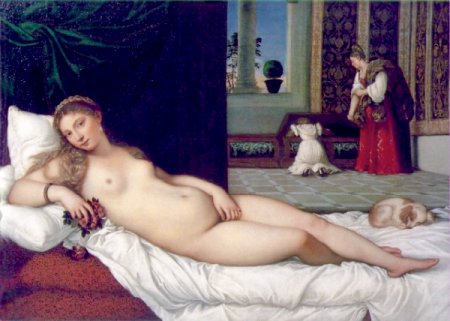
This book (sort of) does for Titian’s “Venus of Urbino” what the gorgeously beautiful movie “Girl With a Pearl Earring” did for Johannes Vermeer’s painting of the same name. Dunant imagines the languid nude in the groundbreaking Titian painting to be Fiammetta Bianchini, a prostitute who is swept up in the sacking of Rome in 1527, although most of the action takes place in Venice.
The author expertly mixes the imagined life of Bianchini with historical events. (FYI, “Venus of Urbino, pictured above, was groundbreaking because Titian broke a cardinal rule of 16th century painting that only mythological figures could be portrayed in the buff. You might say that “Venus” was the first pinup.)
Memoirs of a Geisha: A Novel (*)
By Arthur Golden (Vintage, 1997)
This is an interesting pick with “Memoirs of a Geisha” about to be released on DVD. The movie got lukewarm reviews, which is not surprising since the book on which it was based did not translate easily to celluloid.
Golden writes about the life of a geisha from her origins as Chiyo, a beautiful orphaned girl from a remote Japanese fishing village in 1929, to her career as Sayuri, a leading courtesan (but not a prostitute in the Western sense) in the finest geisha house of Kyoto during and after World War II, and then her retirement to New York City, of all places. Golden literally and figuratively gets under Sayuri’s kimono in this fascinating and beautifully written book.
The Seashell on the Mountaintop: A Story of Science,
Sainthood and the Humble Genius Who Discovered
a New History of the Earth (*)
By Alan Cutler (Dutton, 2003)
Long title, short book, and a great example of making science accessible to the Average Joe. Nicolaus Stenonius, or Steno, was a brilliant Danish doctor of anatomy in the 17th century who became the father of modern geology. He proved that in the sequence of rock strata, the oldest rocks are at the bottom, that water is the source of all sedimentary rocks, that these water-generated sediments travel far and wide and, as the book's title implies, that includes up onto mountains far from their origins.
Steno’s discoveries ran afoul of the Roman Catholic Church, and mindful of Galileo’s fate, he balanced his hypothoses with Scripture, even when he knew the Scripture to be wrong, thereby living to tell the tale.
* * * *
Here's how the Kiko's House Book Club works:
Whenever you read a good book or may have read one in the past that you'd recommend to your fellow visitors, e-mail me at kikokimba@gmail.com
Include in the body of the e-mail the book's title, author and type (fiction, nonfiction, bio, advice, etc.) and a few words about why you enjoyed and would recommend it. I'll post your recommendations at the next Book Club meeting.
By the by, my all-time favorite book recommendation came from Albert Einstein, who besides being the patron saint of Kiko's House, famously remarked that:
This paperback is very interesting, but I find it will never
replace a hardcover book -- it makes a very poor doorstop.
No comments:
Post a Comment