Thursday, January 04, 2007

Iraq: Transcripts du Jour on the War

Brian Williams: First, NBC News Pentagon correspondent Jim Miklaszewski has learned that President Bush is prepared to announce a strategy of surge and accelerate in Iraq, which would involve some 20,000 additional American troops being sent to Iraq. Jim is with us from the Pentagon with more on this tonight. Jim. Good evening.

Miklaszewski: Good evening, Brian. Administration officials told us today that President Bush has now all but decided to surge those additional troops into Baghdad to try to control over the violence there and only then could they accelerate the turnover of territory to Iraqi security forces. Fact is they’re not up to the task yet. The plan would also throw more U.S. money at Iraq for reconstruction and a jobs program. Interestingly enough, one administration official admitted to us today that this surge option is more of a political decision than a military one because the American people have run out of patience and President Bush is running out of time to achieve some kind of success in Iraq. While this plan will clearly draw some stiff opposition on Capitol Hill, the president is expected to announce it a week from today.

Williams: Jim Miklaszewski on duty for us today. Thanks for that.

Thanks indeed, Jim. For pointing out -- as is noted in the italicized passage -- that even at this late date, politics (ie., covering the president's ass) is the tail that wags the Iraq dog.

Meanwhile, Keith Olbermann gets it just about right in this fiery MSNBC commentary:

This senseless, endless war.

But it has not been senseless in two ways.

It has succeeded, Mr. Bush, in enabling you to deaden the collective mind of this country to the pointlessness of endless war, against the wrong people, in the wrong place, at the wrong time.

It has gotten many of us, used to the idea — the virtual "white noise" — of conflict far away, of the deaths of young Americans, of vague "sacrifice" for some fluid cause, too complicated to be interpreted except in terms of the very important sounding, but ultimately meaningless phrase, "the war on terror."

And the war's second accomplishment — your second accomplishment, sir - is to have taken money out of the pockets of every American, even out of the pockets of the dead soldiers on the battlefield, and their families, and to have given that money to the war profiteers.

Because if you sell the Army a thousand Humvees, you can't sell them any more, until the first thousand have been destroyed.

The service men and women are ancillary to the equation.

This is about the planned obsolescence of ordnance, isn't, Mr. Bush? And the building of detention centers? And the design of a 125-million dollar courtroom complex at Gitmo complete with restaurants.

At least the war profiteers have made their money, sir.

And we here highly resolve that these dead shall not have died in vain.

About That Electric Bill, Mr. President

Now I know why the city in which I live never got my December electric bill payment.

More here.

My Sweet Ford

Am I the only one who thinks that the tributes to Gerald Ford are lasting longer than his time in office?

Nah. The Scribe over at Highway Scribery agrees -- and then some:
"Let's be frank (and joe) here, 'decency' is a very nice quality, but it doesn't make for either a great presidency nor amount to much of a legacy.

"And, of course, the endless focus on this particular, apolitical quality is merely a reflection on the Bush administration's Washington, where decency is in short supply."
More here.

Irony Alert! Irony Alert!

Virgil Goode, a knuckle dragging Republican congressman from Virginia, has been beside himself over fears that Islamic extremists will be emboldened by the decision of newly elected Representative Keith Ellison to take his ceremonial oath of office on a Koran rather than a Christian Bible.

Ellison, a Minnesota Democrats, is the first Muslim to be elected to Congress.
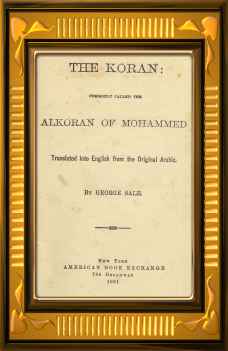
Ellison will take the oath today at the Capitol on the 1750s English translation of the Koran (see photo) owned by Thomas Jefferson, who was born in Albemarle County, which Goode represents.
The book's all-American provenance seems to have shut up Goode, but for how long?

This is a Raid! This is a Raid!

When things are slow at blogs specializing in women's issues, there's always Liz Funk to shake things up.
Funk, a Women's News correspondent, says that women who go out to bars -- and worst yet bars that have women's drink specials (!!!) -- are sluts who are almost asking to be raped.
Predictably, bloggers from Jill at Feministe to Ann at Feministing have again risen to the bait. They hear the Feminist Police banging on their doors and a pushback of battle royal proportions is underway.
Lindsay at Majikthise comes down somewhere in the middle. That is where this bald but hunky fiftysomething guy who made the rounds before women's drink specials (but has a 21-year-old daughter) finds himself.
Meanwhile, a roundup of reaction at Alternet.

Photography: 'A Triple-Edged Sword'

Cambodian Musician
Steve Goodman, whose beautiful photography is oft featured at Kiko's House, is profiled at Black Star Rising, a cool new photography blog.

An excerpt:
"With my photography I try to reveal what I see and how the world is, but it’s a triple-edged sword. Firstly photographs serve to show how things are outside of us. Secondly they help to reveal how things are inside of us. I am never responsible for whatever feelings and emotions that may be stirred within someone who sees one of my photos - that becomes part of their own individual and private experience. Thirdly, just as a movie reviews often reveal more to us about the reviewer than about the movie being reviewed, sometimes my photos are more revelatory about who I am than they are about the particular subject at hand."
More here. To check out Steve's photo blog, click here.

The Iggles Are Jinxed!

Wednesday, January 03, 2007

GM: Still Clueless After All These Years

This is a make or break year for a once mightly colossus known as General Motors.

I trace the beginning of GM’s downturn from a leading automotive innovator to the maker of boring rental cars back to 1976 when a peppy little import called the Honda Accord first arrived in the U.S.

The 1976 Accord had just everything that the GM cars of that era didn’t.

It was attractive in a cute sort of way. It was larger on the inside than it appeared from the outside, not the other way around. It had a rear hatch that opened to a collapsible back seat, offering lots of storage space. It handled well, had some oomph and was economical, which was no small thing arriving as it did between the two 1970s oil crises. A practical friend who had owned GM cars forever bought a silver '76 Accord and was hooked. I drove it and was hooked, too.

GM’s response to the Accord and successive waves of hot selling offerings from Honda and later Toyota and Nissan (nee Datsun) was to continue churning out formulaicly unattractive and uneconomical cars of dubious quality. In fact, GM’s only direct response to the first wave of the so-called Japanese Invasion was an abomination called the Chevette.

The General’s fortunes briefly improved after Rick Wagoner took over in 1992 and GM's share price soared to a record $90. But beneath the gloss the same fundamental problems persisted, eating into the huge corporation like rust spreading through the underbody of an old Cadillac Coupe de Ville.

These problems included overcapacity – too many assembly plants and not enough orders -- and except for 1998, when there was a seven-week strike, sweetheart contracts with the United Auto Workers union.

But the biggest problem was that Wagoner’s GM was coasting along with that same tired product line as much of the rest of the automotive world was stealing a march on it with attractive and innovative products.

One GM brand was virtually undistinguishable from another. Calls to cut back on the duplication of models between brands and to even fold the lesser selling brands went unheeded until Oldsmobile was belatedly put out of its misery in 2004. (Buick needs to go, too.) Most ominously for GM, Japanese automakers were opening U.S. plants and turning out cars (and later small pickup trucks and still later big pickup trucks) that were as well made as those at their vaunted home plants while GM’s U.S. plants continued to produce poorly made vehicles.

In 1992, the year Wagoner took over, GM sold 35 percent of all cars sold in the U.S.Today it sells 29 percent. Last year it suffered its biggest loss since the Great Depression. It it expected to do only slightly better -- or less worse -- when the books are closed on 2006. Meanwhile, this past spring it invited its heart and soul -- its 113,000 hourly workers -- to take a hike through incentives of up to $140,000 apiece.

It is increasingly difficult to see how Chapter 11 bankruptcy can be avoided as Toyota, which already has overtaken Ford as the No. 2 worldwide seller, sets its sights on the General. (By the by, in their own ways Ford and Daimler Chrysler are in just as bad a shape.)

The question is not whether Toyota will become top dog, but when. My guess would be sometime in 2008 if current trends continue.

* * * * *
Hindsight being what it is, it’s easy now to see that Wagoner was the wrong choice to turn GM around. Wall Street knows that. The car dudes who write for Motor Trend and Automobile know that. Consumers know that. Wagoner and the GM board just happen to be the last people to know that.

Wagoner came up through GM’s financial division rather than manufacturing or sales, which may explain why he has been slow to recognize virtually every major automotive trend that has occurred on his watch.

These trends include minivans, smaller SUVs (Wagoner bought the Hummer brand just as the mega-SUV bubble was bursting) and an increased environmental awareness. GM has been ridiculously slow to embrace now popular gas-electric hybrid vehicles. It has no hybrids in showrooms today, while Toyota-Lexus has 12 models, including the Lexus GS450h, a $70,000 green sports luxury machine. Toyota-Lexus will soon have 20.

GM has survived because it still makes a heck of a lot of cars -- and trucks. It just doesn’t make money. (Its ossified dealer network is in even worse shape than the mother ship, but that's another story.)

In flailing around for a way out of its torpor, GM has become addicted to big rebates and zero-interest financing plans. Things got so bad that it offered deep employee discounts to the general public. Sales perked up, but plummeted when the discounts ended. GM even ran a national ad campaign apologizing for its lousy performance and promised a return to the glory years. The background music was the sound of my GM-proud father spinning in his grave.

There have been successes on Wagoner's watch, but I can count only four of consequence.

* He successfully nurtured Saturn as an un-GM brand.

* He has encouraged the near-death Cadillac division to shed its Geritol image. It now caters to the Led Zeppelin crowd and offers a line of trendy and well-made models, which while not my cup of tea, show that there’s life yet in the General.

*
He has made big inroads into China, the third-largest and fastest-growing market.

*
He has cut costs and manufacturing capacity.

But Cadillac is a niche brand and GM has yet to offer a mainstream success remotely approaching the VW Passat or Toyota Camry, which is the best selling car in America. Or the still hot selling Honda Accord. (I bought my mother an Accord in the mid-1990s with the money she got from selling her GM stock. Ha!)

No, make that only three successes on Wagoner's watch.

After successfully nurturing Saturn, Wagoner has allowed the once innovative spinoff to be dumbed down into the rest of the corporation. Saturn sales have tanked.

At this point, it's not a matter of General Motors emerging from its long self-inflicted nightmare smaller and leaner. It's a matter of surviving, which makes bankruptcy actually look pretty good since Wagoner has pinned GM's hopes on, of all things, a new line of tarted up big SUVs like the Cadillac Escalade and ChevyTahoe.

Why should we care about any of this? Because GM is still so large and draws from so many suppliers that a terminally illness would reverberate throughout the U.S. economy.
Wagoner has had 14 years to fix GM’s problems. He has only added to them, and the proof is that it still makes an enormous amount of boring crap.
It’s time to go, Rick. And don’t let the door hit you in the butt on the way out.

Oh, by the way, GM’s share price closed last week at $29 and change.

A FOOTNOTE
General Motors unveiled the next generation Malibu today. While it looks like a cross between a Ford Five Hundred and Audi A8, market analysts like what they see -- a mid-sized sedan that has a fighting chance to regain some market share.
When Good Statistics Do Bad Things . . .

My brain nearly exploded when I did some number crunching and found that more U.S. soldiers died in the Iraq war in 2006 than Iraqi soldiers.
Some 870 U.S. soldiers died, compared to 627 Iraqi soldiers.
What the bleep gives?

What gives is that these statistics don't tell the whole story. The whole story, according to people with whom I spoke who have spent considerable time on the ground in Iraq, is that the national police still do the brunt of the dirty work for the Iraqis.

Says Buck Sergeant from American Citizen Soldier:
"The Iraqi Police bear the brunt of the fight because they necessarily have the most day-to-day contact with the areas they patrol. Additionally, they live at home rather than on military compounds, thus they must commute back and forth to work each day which exposes them to kidnap and assassination which happens frequently.

" . . . the Iraqis indeed face most of the dirty work in the country, and have for some time now. Americans are only exposed to danger when they choose to be by leaving the confines of the FOBs [forward operating bases] and venture forth to do their jobs. Iraqis face it 24/7 and have little choice in the matter."
And Bill Roggio from The Fourth Rail, who is just back from a December embed with a Marine unit in Falluja:
"Police are easier targets. They drive thin-skinned vehicles by and large, while the Iraqi army has Hummers, Cougars, etc. The Iraqi army units I embedded with weren't on the roads much in vehicles, they mainly were doing foot patrols. Which are harder to target with IEDs, because dismounted soldiers can more easily ID the IED indicators and can hunt down the trigger man

"In Fallujah, the police suffered over 21 dead since the unit I embedded with got there four months ago. The police are better targets because they are a greater threat. Since they live in the communities, they are a better source of intel, know the lay of the land, and so on.
Bill says that the moral of the story is to never just look at casualty numbers.
"They don't tell the full story. I hate it when bloggers on the left use casualty numbers to show things are getting worse, and when those on the right use the numbers to show things are better than they seem. Its just a poor metric unless the goal is political points."
Amen.

. . . Bad Statistics Do Good Things . . .

The remaining hardcore supporters for the Iraqi war like to note that previous wars were far more deadly. What's 3,000 dead Americans when 400,000 Americans died in World War II and 20,000 alone in the Battle of the Bulge?
Why then are Americans far less tolerant of Iraqi war deaths?
The Associated Press put that question to a bunch of smart people with big titles, concluding that:
* Fewer deaths are more keenly felt.

* Support for the war has declined far more quickly than the Korea or Vietnam wars.
* Americans are more sensitive to casualties than in past wars because they neither see vital interests at stake nor feel the "halo effect" from a clear prospect of success.

*
Many people have no idea who the U.S. is fighting and what for because of the White House's changing rationales.
* "Speed-of-light" consumer conveniences like cell phones and digital cameras reinforce expectations of fast results.
More here.

. . . Bad Presidents Blame Good Generals . . .

The latest White House spin -- certainly the most preposterious to date -- on why the Iraqi war is a big freaking mess is that it's all the fault of Army General George W. Casey Jr.

This is because:
Casey, as the top American commander in Iraq, should not have gone along with the Bush administration policy to maintain current troop levels. The result was that the U.S. constantly found itself a step or two behind what was happening on the ground.
If that isn't rich enough, try this nugget from a New York Times analysis:
White House insiders say the president lost faith in Casey some time ago, but it would having been politically . . . er, impolitic to say so before the midterm election.
Yessiree, declaring that a course correction was necessary would have painted the president as a gutless weenie.

The whole sordid story is here.

. . . And a Bad Man Gets a Good Lynching

You don't have to be a Sunni to be horrified by the manner in which Saddam Hussein was executed.
This Al-Maliki government rush job took on the air of a Shiite sectarian lynching with the former dicator, the noose around his neck, being taunted by shouts of “Go to hell!” and “Moktada! Moktada! Moktada!” — a reference to the radical Shiite cleric Moktada Al-Sadr.
Josh Marshall speculates that the man who took the Saddam hanging snuff film is none other than Mowaffak al-Rubaie, Iraq's national security adviser.

Predictably, the circus has provoked outrage and rioting among Sunnis who do not need to be reminded that Al-Sadr has directed death squads that have killed thousands of their brethern.

Once upon a time, Saddam's execution was seen as an opportunity for the closure that Iraqis so badly need, a chance to exorcise demons.
Instead, it is the death rattle for the last chance for Sunni-Shiite comity.

Quote du Jour on the War

"I cannot have been the only one to have spent the Christmas break wrestling with the central question we have to answer in 2007: what to do in Iraq. The more you ponder it, the harder a call it is. It seems to me we have to leave behind recriminations against the Bush administration. History will damn this president sufficiently. There is no need for us to pile on now. The question is simply: what is in the best interests, first, of the United States and second, of Iraq? And yes: the American priority is clear. A serious foreign policy places national interest first and foremost in its judgment. . . .
"I'll wait to hear what the president has to offer in detail before making a clear decision in my own mind. But my view right now is that we should withdraw most combat troops by the middle of this year; and leave a remaining force in the Kurdish region and along the Iraq-Turkey border. Protecting the fledgling democracy in Kurdistan and reassuring Turkey should be our top priorities. This will force Iraqi indigenous forces to come up with their own leader, a man who has real power and a capacity to restore order, however brutally. . . . The current chaos ties the U.S. down in a hideously tightening vise. We have to change the dynamic and actually do something we can accomplish. We cannot win this civil war for any side, and we shouldn't. We can, however, withdraw. . . .

"The moral cost of withdrawal is huge. We should do all we can to provide amnesty for any Iraqis who have been loyal to us. (It does not surprise me that we shamefully haven't. This is the Bush administration.) But the moral cost of plowing on is also exponential. It may merely delay the day of reckoning. It risks sending young Americans to die in order for a president to save face, not in order to win. The truth is: we have lost this battle, if not the war. I am still inclined to believe such a loss was avoidable. The amazing restraint of the Shia for so long, and the enthusiasm for elections, revealed the potential in Iraq for a breakthrough. But this president threw it away. There is no getting around this, I'm afraid. It is reality. And if we do not get out by June, I fear an even worse one."

Bill Bennett Blows a Fuse

For being an accidental president, Gerald Ford was a pretty good one (restoring integrity to the office, yada yada yada). And while I have blogged on the other two thirds of the Famous Dead Guys Holiday Trifecta (James Brown and Saddam Whatshisname), I haven't felt like I could add anything to the discussion on Mr. Ford.

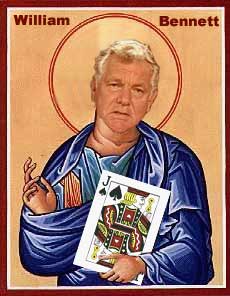
I was right, although I did come upon a (pardon the term) drop-dead funny post by Jon Swift, who skewers the smarmy William Bennett for taking issue with the late president calling the Iraq war a "mistake" in an interview with the WaPo's Bob Woodward that was published posthumously.

Says Jon:
"Bennett is right. Releasing the interview posthumously deprived us of the opportunity to accuse the 93-year-old former President of being a traitor and of wanting America to lose. And so instead of having a 'dialogue' with Ford about the War in Iraq, Bennett was forced to accuse Ford of being a coward and not being 'decent,' while Ford -- conveniently -- 'doesn't have to defend himself,' according to Bennett. By dying, Ford effectively cut and run from any discussion about why he hates America.

"Once someone has died, it's a lot more difficult to attack them without people thinking you are being unseemly. While it was very courageous of Bennett to do so anyway, his words have opened him up to a torrent of criticism, the kind of criticism that Ford avoided by dying. Bennett realizes that it would have made him look a lot better if he had picked on a 93-year-old man while he was still alive instead of the day after he died, but Bennett cares more about this country than he does about what people think of him personally. It's too bad that Ford was not as brave as Bennett is."
More here.

Monica: We Still Hardly Know Ye

There are few public humiliations in modern American history bigger than that suffered by Monica Lewinsky. Nor, I believe, few people who have been more resilient in the face of a media gang rape than the former White House intern has been.

As a reporter who covered the Clinton impeachment scandal, I became more familiar with Lewinsky than most people, and the more I learned about her the more fond I became of this smart, personable and utterly mischaracterized young woman whose youthful indiscretion got the best of her.

Now comes Richard Cohen, the WaPo op-ed columnist, to try to set the record straight:
"In the various books I've read about the Bill Clinton impeachment scandal -- a scandal because of what was done and a scandal because the president was impeached for it -- the same story is told over and over again. When the prosecutors or lawyers or whoever finally got to meet the storied Monica Lewinsky, they were floored by her. She was smart, personable and -- as the record makes clear -- dignified. This is more than can be said about some of the people who write about her.

"I will not name names. But in recent days, Lewinsky has been back in the news. In December she graduated with a master's degree in social psychology from the London School of Economics. Her thesis was titled 'In Search of the Impartial Juror: An Exploration of the Third Person Effect and Pre-Trial Publicity.' Her thesis might well have been called 'In Search of the Impartial Journalist,' because she was immediately the subject of more poke-in-the-ribs stories about you know what. The Post, a better paper than it was that day, called her 'dumb-but-smart.' It was more than could be said for that piece.

"It does not take a Freudian to appreciate why Lewinsky chose the topic she did. She is a victim of publicity, and her life has been a trial -- enough to floor almost anyone. But in Lewinsky's case, she took a bad situation and made something good of it. That hardly makes her 'dumb-but-smart,' but rather once young -- and now older and incomparably wiser. An approximation of this befalls us all, but before we got to become wise and prudent in all things we were probably irresponsible, outrageous and wild -- in other words, young."

More here.

Meanwhile, Captain Ed at Captain's Quarters named names and criticized the offending reporter -- Libby Copeland-- the day the story ran.

More here.

Tuesday, January 02, 2007

Are We a Nation of Sheep?

Please skip this post and continue on your way to the mall to return that hideous necktie that your mother-in-law gifted you if you don't believe that President Bush has been a bad president, that the war in Iraq is an unmitigated disaster, and you don't occasionally lie awake nights fearing for the future of the United States.

Still here? Good.

Given the dire straits that sentient Americans find themselves in, the big questions of New Year's 2007 are:
* Have we become a nation of sheep?

* Can we survive two more years of a Bush presidency?
Let's mull the ovine question first because it gives me an opportunity to mention a dear friend.

BAAA!!! . . .
As I have written early and often, other than the impeachment crowd at the Daily Kos and other liberal-lefty blogs, the silence has been deafening when it comes to Americans demanding that President Bush be accountable for his actions, let alone pull the U.S. back from the brink of myriad disasters.

While other aspects of a post that I put up last month at The Moderate Voice on the Joint Chiefs of Staff standing up to the president got plenty of comments, the usually feisty readership of this popular centrist blog was struck dumb (or is it dumbstruck?) when I asked why the U.S. was so different than other countries. Countries where the intransigence of a so-called leader like George Bush in the face of a train wreck like the Iraq war would lead to calls from the body politic for his ouster or even result in a putsch.

Have we become a nation of sheep, so inured to arrogant and inept leadership and a corrupt political culture (yes, both Dems and GOPs) that we would rather retreat to our Barcaloungers than fight?

That aforementioned dear friend, W. Russell G. Byers, would think so.

Russell was born with a silver spoon in his mouth and a Republican Party membership card in his diaper. He graduated from Yale the year the president was a freshman and three years after the graduation of another worthy who had two middle names, lifelong friend John H.J. Heinz, the late great moderate Republican senator from Pennsylvania.

Like Heinz, Russell could have done almost anything -- or absolutely nothing -- but in the finest tradition of noblesse oblige, devoted his life to public service.

I met Russell in 1989 when this genteel and smartly dressed conservative hired on as a columnist for the Philadelphia Daily News. His editor was Yours Truly, a jeans wearing and bare knuckled liberal Democrat.

Neither of us backed away from a fight and had the conviction of our beliefs, but we deeply respected each other and our relationship thrived.

Ideas flowed from Byers' fertile mind in torrents. Solving the homeless problem. Tax reform. The need for more drug rehab facilities. A makeover of the Philadelphia tourist industry. But the words themselves usually did not come so easily and that's where I came in.

Russell would have burned his Republican Party card in Lafayette Park had he lived to see the disintegration of a GOP Big Tent that once had plenty of room for a John Heinz, let alone the ascendancy of the Christianists who elected a president who championed their culture wars while recklessly starting the kind that has real bullets and bombs.

I can hear Russell now, his face becoming flushed as he chain smoked one Lucky Strike after another:
"Why are people letting George Bush get away with this? Are Americans sheep?"
Like I said, Russell never backed away from a fight, including his last one. He was stabbed to death a few days before Christmas 1999 by a knife-wielding assailant.

. . . AND BAA HUMBUG
I am neither paranoid nor particularly prone to flights of fantasy, yet I find that the answer to my second question is disturbing given the state of world affairs:
Can we survive two more years of a Bush presidency? Maybe not.
With a conspicuous exception, Bush's domestic agenda is not worth the powder to blow it up with. As it is, there's precious little money to fund anything not swabbed in camouflage owing to the enormous drain on the national treasury because of the war, some $345 billion to date and counting.

Where the pyrotechnics could occur is the Middle East.

The president has three options there:
(1.) He continues to drive Iraq toward catastrophe, thereby sealing his legacy as the worst U.S. president in history.

(2.) He picks an unwinnable fight (sound familiar?) with Iran, thereby sealing his legacy as the worst U.S. president in history by igniting a regional war -- and then some as the shockwaves spread to Muslim countries outside the region -- that would make Iraq look like a pillow fight.

(3.) He cherry picks a victory from the jaws of defeat and, say, brokers a peace deal between Israel and Palestine, thereby sealing his legacy with an asterisk. (Save for that peace deal, he was the worst president in U.S. history.)
The first option certainly plays to the notion that Bush would like nothing more than to wait out his days and dump the whole mess on his successor.

The third option is unlikely because the Bush version of diplomacy has been "my way or the highway," and he adamantly continues to refuse to engage Iran and Syria in finding an Iraq "solution."

Where I get chest pains is in contemplating the second option. Sucker punching Iran over its nuclear sites does not seem farfetched when you consider how the world has changed for the worse since March 2003 when Bush sicced the mightiest military on the planet on Saddam Hussein and has seen that military fought to a bloody stalemate by a rag tag assortment of insurgents and other irregulars.

Then there is that aforementioned conspicuous exception: The backwash from the Iraqi war in the form of the erosion of civil liberties under the guise of the War on Terror. Beyond the NSA domestic spying program, how many other clandestine intrusions into Americans' lives are there?
All I know is that it's going to take helluva lot more than a wing and a prayer to get through the next two years.

Does Osama Use an Electric Toothbrush?

Don't know about you, but I arose today and went about my morning constitutional just as I did before Saddam Hussein was hanged. As I peered in the bathroom mirror at my grizzlded visage, I did wonder whether Osama bin Laden uses an electric toothbrush or the old-fashioned kind in his mountain redoubt.

What do you think?

GREAT MINDS THINK ALIKE
Juan Cole, the emminent if occasionally annoying authority on the Arab world, comes to the same conclusion in a Salon commentary on Saddam's swan song as did Yours Truly.
"Through the bumbling of the U.S.-backed regime, justice becomes revenge, and a despot becomes a martyr."
My take is here.

Then there's Josh Marshall, who gets the Most Eloquent prize for a commentary he put up at Talking Points Memo in the hours before the execution.

ONWARD INTO THE PAST
It's kind of sad but not surprising that many mainstream media reporters and most definitely their editors still cannot factor the blogosphere into a major breaking story like Saddam's Sayonara.

An example is Alessandra Stanley's "TV Watch" column in the Sunday New York Times on the pre-execution death watch by the cable news channels and the networks and then the scramble to broadcast Iraqi TV footage when the door opened under the Terror of Tikrit.
No mention that blogs were all over the story in ways that CNN and their ilk were not. Stanley seems so oblivious to the blogosphere that her piece reads like it could have be written five or 10 years ago. Just change the news event to fit the time.
RUSH TO JUDGMENT
Aussie blogger Mark Holder wonders whether Saddam was hanged before his second trial on the 1988 poison gas attack in Halabja because of the covert roles that the U.S., British and French governments played in helping Iraq obtaining chemical weapons technology.

The New York Times takes a stab at why the 30-day appeals period was ignored here and does a dandy job of missing the main point:
Saddam would not have been hanged when he was hanged without U.S. approval. Period.
Chris Floyd is less kind at Empire Burlesque in savaging the Times for taking at face value a statement from a faceless Baghdad official that the U.S. had no issue in handing over Saddam to the Iraqi government but needed everything to be done in accordance with the law.: "You must admit this is rich: Bush officials -- creators of the special 'military tribunals' for their special, made-up catagory of 'enemy combatants' who can be jailed indefinitely without trial or charges or even killed, all at the arbitrary order of the omnipotent president -- fretting over 'due process' for Saddam Hussein. American citizens are no longer guaranteed due process -- which is now solely in the Decider's gift -- but we are going to believe that Saddam's rights were uppermost in the Occupier's mind before his execution."

AN XXX-RATED HANGING
Finally, I urge you to watch the entire hanging here as captured by a camera cellphone.
It gives new meaning to the concept of pornography, doesn't it?
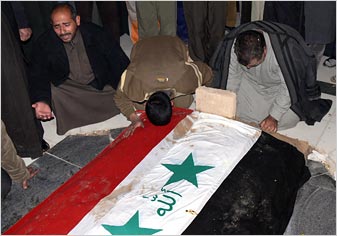
(Photograph by Bassim Daham / The Associated Press)

Month 45 of the War By the Numbers

Happy revelers at post-Saddam execution victory party in Baghdad
December 2006 was a month for the record books, but one statistic is not likely to make the evening news:
With the 3000th U.S. soldier dying on New Year's Eve, more Americans have now been killed in Iraq than in the 9/11 terror attacks.
DECEMBER 2006 ROUNDUP
1,751 --
Iraqis killed, including Saddam Hussein (*)
117 -- U.S. troops killed
0 -- Military funerals attended by President Bush

2006 ROUNDUP
16,273
-- Iraqis killed
(Includes
14,298 civilians, 1,348 police, 627 soldiers.)
871 -- U.S. troops killed
0 -- Military funerals attended by President Bush

U.S. WAR-TO-DATE ROUNDUP
3,003 -- Total killed to date

(Following statistics are through 12/02/06)
1,766 -- Killed in action
545 -- Died of wounds
7 -- Died while missing in action
2 -- Died while captured
374 -- Died in accidents
56 -- Died from illness
12 -- Died in homicides
93 -- died of self-inflicted wounds
7 -- Undetermined
26 -- Pending classification
22,057 -- Total wounded

(*) Includes Iraqi Army personnel, security forces, national police and civilians.

(**) Includes 14,298 civilians, 1,348 police and 627 soldiers.

Sources: Iraq Coalition Casualty Count, Defense Manpower Data Center, Iraqi Ministries of Health, Defense and Interior
(Photograph by Qassem Zein/Agence France-Presse - Getty Images)

Quote du Jour on the War

As George Bush's terrorism guru prior to 9/11, Richard Clark has a special credibility when it comes to discussing the Iraq war. After all, it was Clark who told us in "Against All Enemies" that the Twin Towers were still burning when Donald Rumsfeld declared that the major priority was not tracking down Osama bin Laden, but invading Iraq and taking out Saddam Hussein.

Says Clark:
"As the president contemplates sending even more U.S. forces into the Iraqi sinkhole, he should consider not only the thousands of fatalities, the tens of thousands of casualties and the hundreds of billions of dollars already lost. He must also weigh the opportunity cost of taking his national security barons off all the other critical problems they should be addressing -- problems whose windows of opportunity are slamming shut, unheard over the wail of Baghdad sirens."
More here.

The State of the Global Jihad

Bill Roggio has a solid roundup on the state of the global Islamic Jihad over at The Fourth Rail.

Writes Roggio:
"The year of 2006 has seen some interesting developments in the fight against al-Qaeda and its allies across the globe. While the war against al-Qaeda is largely seen as a fight in Afghanistan supported by a police action in certain countries, there is a very hot war occurring in many countries. Al-Qaeda and its allies have initiated hot wars in lesser known countries such as the Philippines, Chechnya, Somalia, and Algeria. Thailand is fighting a serious insurgency against ill-defined groups of Muslim insurgents which haven't been definitively connected to al-Qaeda or the Southeast Asian powerhouse Jemaah Islamiyah, but we don't believe in coincidences."
More here.

(Image: "Jihad V" by Rubbersuit Studios)

Was Saddam Hanged or Hung?

These pearls of wisdom from Frank at iFlipFlop:
"Saddam Hussein was hanged.
Tommy Lee is hung.

"Mussolini was hanged.
William was hung.

"Worley was hanged.
The stockings were hung.

"Generally, people are hanged and objects are hung. Points to those who know the references to William and Worley. That means you and I both read People mag."

Theater Review: 'The Vertical Hour'

“The Vertical Hour,” David Hare’s timely new play, refers to that moment in combat medicine when you can be of some use after a soldier is critically wounded.

Julianne Moore makes her Broadway debut as an American foreign correspondent turned Yale University professor who finds herself caught in a romantic triangle with Bill Nighy, who plays an esteemed British physician, and his son and her fiancé, Andrew Scott, who plays a thoroughly Americanized physical therapist.

“The Vertical Hour” is about sense of self, the death of 1960s idealism and the war in Iraq. But it is the dramatic tension provided by Moore, who is pulled between the affections of her lover and his father, that propels this five-act play, which is directed by Sam Mendes.

Moore, who played the seductress in “The Big Lebowski,” one of my all-time favorite movies, stumbles a bit in the early scenes, while Nighy, whose most recent film credits include the “Pirates of the Caribbean” series, is brilliant from the opening curtain.

The play closes on April 1. The Christmas Week performance that the DF&C and I attended at the Music Box Theater on West 45th Street in New York City was sold out, and I suspect that tickets for this fine limited-run production will be scarce.

Click here for more information.

The Best Music CDs of 2006

Citizen Cope
Wanna know what America is listening to that's not on the radio?

The listeners of WXPN-FM, a leading alternative music station, voted for their top 50 music CDs of 2006, very few of which can be heard on so-called mainstream stations.

Their top 10:

(10.) Supply and Demand (Amos Lee)
(9.) Broken Boy Soldiers (The Raconteurs)
(8.) Every Waking Moment (Citizen Cope)
(7.) Till the Sun Turns Black (Ray LaMontagne)
(6.) We Shall Overcome (Bruce Springsteen)
(5.) The Crane Wife (Decemberists)
(4.) The Information (Beck)
(3.) Eye to the Telescope (KT Tunstall)
(2.) St. Elsewhere (Gnarls Barkley)
(1.) Modern Times (Bob Dylan)

The DF&C and I agreed that our favorite was Citizen Cope's "Every Waking Moment."

More here.

Blog Biz : Score One For the Home Team

There are so darned many blogs that it's easy for the interesting ones to get lost in the crowd.

I stumbled on Rate My Blog, a blog on blogging run by a bunch of enterprising Brits, entirely by accident and submitted Kiko's House for their scrutiny.
The initial response was awful because the reviewers were encumbered by the slow download problems that we suffered through much of the past year. The second response was far better, including praise for content and writing and some suggestions on improving our appearance that we're beginning to initiate. (See next post for details.)
Rate My Blog has added a new feature -- interviews with bloggers, and Yours Truly is the first victim . . . er, subject.

Click here and then click on the Adobe Acrobat icon to read the interview.

Click here (and go through a simple registration procedure) if you'd like to rate Kiko's House or any other blog.

Blog Biz II: New Face, Same Old Jive

You may have noticed that Kiko's House is looking different these days.

We're doing a makeover from our nameplate on down with the help of an expert on blog formatting and the usual sage advice from the cats.
I know about as much HTML as I know Urdu, so that even with expert help the makeover is going to be a long slog.
If there's anything you don't like about it or have suggestions, please speak up.

Monday, January 01, 2007

New Year's Greetings From Kiko's House

THE DARKING THRUSH
By Thomas Hardy
I leant upon a coppice gate
When Frost was spectre-gray,
And Winter's dregs made desolate
The weakening eye of day.
The tangled bine-stems scored the sky
Like strings of broken lyres,
And all mankind that haunted nigh
Had sought their household fires.

The land's sharp features seemed to be
The Century's corpse outleant,
His crypt the cloudy canopy,
The wind his death-lament.
The ancient pulse of germ and birth
Was shrunken hard and dry,
And every spirit upon earth
Seemed fervourless as I.

At once a voice arose among
The bleak twigs overhead
In a full-hearted evensong
Of joy illimited;
An aged thrush, frail, gaunt, and small,
In blast-beruffled plume,
Had chosen thus to fling his soul
Upon the growing gloom.

So little cause for carolings
Of such ecstatic sound
Was written on terrestrial things
Afar or nigh around,
That I could think there trembled through
His happy good-night air
Some blessed Hope, whereof he knew
And I was unaware.