MORE HERE.


Nellie McKay is one of those artists you'll be glad you saw on the way up (like catching Bruce Springsteen in a small club, which I happened to do in 1973). This is because McKay's star is burning brightly these days and she is going to be big.
McKay (pronounced mick-kai) detonated her vocal dynamite on Sunday evening at the Deer Head Inn, a Delaware Water Gap, Pa. institution that happens to be the oldest continuously running jazz club in the U.S. It was the eve of her week-long residency at the 54 Below supper club in Manhattan's Theater District, just off Broadway and a few blocks from Carnegie Hall, two venues where she no doubt will be a headliner some day.
Beyond being a terrific singer (and a damned good pianist and ukelele player), a big part of what makes McKay so special is the consciousness raising message she brings to the stage while stopping thisshort of being drop-dead funny. There is not another contemporary artist, let alone one so at home with jazz, rock, pop and torchlight standards, who so lethally combines the serious and the hilarious. Neither has undercut the other whenever we have seen her high-wire act over the years, and the balance between the two poles was pitch perfect at the Deer Head even when, in one between-songs monologue, she took off on rapacious developers who have despoiled her native Poconos, turning the once lovely region into one big waterpark and strip mall.
McKay is touring in support of My Weekly Reader, a new album of covers of iconic 1960s songs her mother played when she was a little kid growing up near the Water Gap. These include hits by The Beatles, Crosby Stills & Nash, Gerry and the Pacemakers, The Small Faces and Herman's Hermits (whom I saw in another small club in 1967; some guys calling themselves The Who opened for them). There also are lesser known songs by Frank Zappa, Richard and Mimi Farina, Country Joe McDonald and Moby Grape.
McKay's lilting soprano is hard to pin down, but there is a bit of Billy Holiday and a lot of Doris Day in it. In fact, in 2009 she recorded Normal As Blueberry Pie, a tribute album to Day -- like herself a rabid animal rights activist. (Ever the contrarian, she wanted to name her 2003 debut album Penis Envy, but her record company objected and it was released as Get Away From Me.)
"The beauty of the Sixties is freedom," McKay says. "Not in the way that the word has been co-opted. The main parts of these movements seem to have been ignored in favor of more trivial aspects. What goes unmentioned about the hippie movement is that it was largely a vegetarian movement. The civil rights movement was largely anti-war. The feminist movement was anti-pornography — that is more relevant today than ever before. This was the generation that ended a war and it was the stonedest generation.
"I cannot believe I still have to protest this shit," she adds.
In a two-set, 27 cover-song ramble, McKay was ably backed by Cary Park on guitar, Alexi David on bass guitar and Kenneth Salters on drums. Highlights included an appropriately bittersweet "Mrs. Brown You've Got a Lovely Daughter" (Herman's Hermits), a spooky "People Are Strange" (The Doors), a bouncy "Compared To What?" (Les McCann and Eddie Harris, among many others), a trenchant "Not So Sweet Martha Lorraine" (Country Joe McDonald), and a driving "Murder In My Heart For the Judge" (Moby Grape). The second encore provided a pitch-perfect ending, a note-warping "Wooden Ships," the great Crosby, Stills & Nash post-apocalyptic anthem.
But McKay's beautiful rendition of the Beatles' "If I Fell" was the show stopper. She sang Lennon's lead part, while she added her dubbed voice twice over to create the McCartney and Harrison backup harmonies on My Weekly Reader, which was produced by Geoff Emerick. Yeah, the same guy who was behind the controls at Abbey Road Studios in 1964 for the original recording of that love song for A Hard Day's Night.
As another reviewer put it, Nellie McKay still wears the mystique of a willful prodigy who is smarter, more talented and hipper than everyone else. Yes, she seems to answer only to herself, but that is a big part of her charm. But see her now while she's still doing smaller places; it won't be the same singing along with a few thousand of her best friends. You have been warned.

So there you are in your 68th year floating merrily down the stream, needing to reach for the paddle only occasionally, while filling bird feeders and trying to stay on your feet in the winter and weeding vegetables and working on your tan in the summer, making sure the dogs and cats get plenty of head scratches and your true love fresh cut flowers no matter the season, keeping your hand in the writing game with a blog post here and a book there, when the phone rings.
"Redz is dead," the caller says solemnly.
Redz is -- or rather was -- Charles Ireland, a friend of many years who befitting his name died on St. Patrick's Day. In bed, not dancing a jig with a pint of Guinness on a bar. The date part later turns out to be untrue, but like other untruths, as well as DC-3 load of true truths, will forever be a part of Redz Lore, joining the stories of how this master mechanic could fix anything, ranging from rotary lawn mowers to propeller aircraft, was a great chef and even greater talker, and early on became an expert cultivator of the ingredient in "left-handed cigarettes," as they were obliquely referred to in testimonials at his memorial service.
The phone rings.
"Rick is dead," the caller says solemnly.
Rick is -- or rather was -- Richard Chamberlain, an acquaintance of several years who died peacefully in his Barcalounger surrounded by family and friends after an illness that had not deterred him from working until the day before he passed away. For Rick, working was a perpetual-motion blur. He was a world-class jazz trombonist, gave music lessons, led a big band orchestra, and quietly made philanthropic gestures to the less fortunate known only to the recipients, although his illness had prevented him from taking his chair as principal trombonist for the New York City Ballet Orchestra for the first time in many years for the ballet's annual holiday production of the The Nutcracker at Lincoln Center.
The phone rings.
"John is dead," the caller says solemnly.
John is -- or rather was -- John Taylor, a dear friend and mentor early in my newspaper career who died after a long illness not unrelated to the Camel cigarettes that typically dangled from a corner of his mouth, sunglasses perched atop his sandy red hair, while he held a phone in one hand and scribbled notes in a reporter's notebook with the other that only a doctor could decipher. He loved the news business, was scrupulously honest and extraordinarily insightful, as well as deeply knowledgeable about public education, which is to say its manifold dysfunctions and chronic lack of adequate funding. Someone needs to name a school somewhere in his honor.
The phone rings.
"Stan is dead," the caller says solemnly.
Stan is -- or rather was --Stan Hochman. Stan was not merely a sportswriter for 55 years, as well as an ink-stained fellow traveler of mine for a goodly number of those years, but one of the handful of sportswriters in the era before the pronoun "I" invaded sports columns like swarms of locusts. He was a rock-solid journalist and not just a clubhouse mooch, and "a homework guy," as a fellow colleague put it, who carried manila folders in his bulging briefcase with notes and yellowed clippings on just about everybody he might want to interview after the big game. He also was a great ballroom dancer, but his favorite move was the circle back -- saving his best question until all the other reporters had left.
* * * * *If I could have only one song with me on a desert island, it would be "Into the Mystic" by Northern Irish singer-songwriter Van Morrison. It has been a steady companion since I bought Morrison's great Moondance album at a record story on the Ginza in Tokyo in 1970. A snippet of the lyric:
We were born before the wind
Also younger than the sun
Ere the bonnie boat was won
As we sailed into the mystic
Hark, now hear the sailors cry
Smell the sea and feel the sky
Let your soul and spirit fly
Into the mystic
And when that fog horn blows
I will be coming home, mmm mmm
And when the fog horn blows
I want to hear it
I don't have to fear it . . .
"Into the Mystic" -- the words and melody ethereally flowing together as one -- is about a spiritual quest. (I know that’s true because Wikipedia told me so.) But over the years the song has become much more -- an affirmation of life for me, and I would like to think for my generation, should we choose to embrace its sentiments, as well as an anthem of lives lived as we float down that stream, merrily or otherwise, after leaving this mortal coil.
I suppose we all grieve in our own ways; my way happens to involve more smiles than tears. Redz, Rick, John and Stan lived extraordinarily full lives. They were not merely good at what they did, they were the best. I am honored that our paths intersected, and am a better person because they did. I have felt their spirits when listening to "Into the Mystic” since I got that first call, then the second, third and fourth calls, over the last three weeks. The foghorn has blown for them and they will be coming home.
It is indeed too late to stop now.

If you have the sinking feeling that the American colossus is becoming a little frayed around the edges, then a new study will be a very cold shower. While the U.S. still has the biggest and baddest military and can wipe out anything and anybody on earth with the flick of a neocon's wrist, while it continues to maintain the technological edge with a tsunami of new products from Apple and other innovators, and while its music and film juggernaut is the undisputed big dog culturally, it has fallen way behind on the things that really matter: Quality of life and commitment to all of its citizens.
The 2015 Social Progress Index ranks the colossus 16th in the world behind the usual suspects, including Scandinavian countries, led by Norway, at the top. Canada (so near and yet so far), is 6th and the rest of the rankings are dominated by core European Union countries, as well as two of the three countries the U.S. defeated in World War II (scusami, Italy). A total of 133 countries were ranked overall, with Chad, Afghanistan and Central African Republic at the bottom.
The U.S.'s ranking in key indicators was:
* 1st in access to advanced education.* 6th in shelter.* 8th in opportunity.* 15th in tolerance and inclusion.* 16th in social progress.* 21st in meeting basic human needs.* 24th in personal rights.* 28th in water and sanitation.* 30th in life expectancy.* 30th in personal safety.* 35th in wellbeing.* 38th in educational equity.* 38th in saving children's lives.* 39th in nutrition and basic medical care.* 49th in high school enrollment rates.* 55th in women surviving childbirth.* 74th in ecosystem sustainability.
To say that Americans focus on the wrong measures in evaluating their country's relative worth beyond financial indicators such as gross domestic product is an understatement. This is because what drives the humiliating ranking the U.S. received overall in the Social Progress Index is poverty, pretty much a non-issue in the national dialogue, such as it is, as well in presidential campaigns past, present and future.
Poverty is strongly associated with low social progress, according to the team that devised the index. This was true for both absolute poverty, the proportion living below a certain threshold, and relative poverty, those earning much less than their peers.
Michael E. Porter, a Harvard Business School prof and team member, notes that it’s important to measure stuff like GDP, but social progress is at least as important because it's a critical measure of how a country is serving its people.
"We’re not now No. 1 in a lot of stuff that traditionally we have been," said Porter. "What we're learning is that the fact that we’re not No. 1 on this stuff also means that we're facing long-term economic stresses. . . . Countries must invest in social progress, not just economic institutions, to create the proper foundation for economic growth."
I hear you, professor, but is anybody listening?

It is difficult to say when Cadillac lost its mojo and began to relinquish its crown as America's leading luxury car to Mercedes and eventually Lexus and other German brands, but I'll pick 1992 when an ungainly and arguably ugly boat called the Cadillac Deville waddled onto the scene.
Since then, it has been pretty much downhill for Cadillac as it lost its stylishness, prestige and for a while its quality. Despite a promising recent resurgence that grew out of General Motors' bankruptcy, the marque has continued to flirt with extinction. But now, in a ballsy $12 billion initiative that includes moving its headquarters from fusty Detroit to Manhattan's chic SoHo neighborhood, Cadillac is rolling out a new line of cars it claims will live up to its new Daring Greatly slogan and ad campaign.
While the first new model out of the gate, the full-sized CT6 sedan (which borrows from the naming nomenclature that Mercedes, BMW and Audi have long used) is a dazzler, it is too little too late.
"The world doesn't need another big German luxury car," says Cadillac marketing boss Ewe Ellinghaus, a former BMW executive. He is more correct than he would ever admit. The CT6 and the other new cars in the pipeline will "capture an American spirit in design and performance," as he puts it, without trying to emulate the Mercedes S-Class, BMW 7 Series, Audi 8 Series or Lexus LS460, but it just doesn't seem distinctive enough at a time when there is a growing homogeneousness among car brands.
Cadillac is battling years of self-inflicted cultural inertia while trying to get a foothold in the intensely competitive luxury car segment, as well as hoping that when members of Generations X and Y, including those all-important Millennials, refer to "their grandfather's car" they're talking about imported luxury brands that Baby Boomers have bought in droves and will embrace Cadillac as "the new cool," as Ellinghaus puts it.
But while the CT6 is an eyeful, it just doesn't strike me as a Mercedes beater. And the Daring Greatly slogan is itself suspect because Cadillac's success will be built on engineering and performance, neither of which are exactly daring. Besides which, people don't typically own or drive cars in SoHo.


Being young is to love Joni Mitchell's music. Growing older is to understand why you do.
I had an enormous crush on this Nordic beauty four years my elder (high cheekbones and bangs, oh my!)
as she broke out of the folk scene in the late 1960s and delivered a series of great albums, each one better than the next and peaking with Hejira that mirrored our more or less parallel lives of loving hard and living high, much of the time on the road.
That crush evolved into a deep if non-romantic love as Joni moved away from her cycle of self-discovery albums into a series of audacious explorations like Don Juan's Reckless Daughter, Mingus and Shadows and Light that confounded her fans and flummoxed many critics.
Joni was hospitalized on Tuesday and underwent surgery after being found unconscious in her longtime home in Bel-Air, a Los Angeles suburb. At age 71, she has grappled for years with what she describes as "a survival blur" of health issues, has had a well deserved case of the ass concerning how aging woman celebrities are judged differently than men, and has made few public appearances. She was inducted into the Rock and Roll Hall of Fame in 1997 and released the four-disc retrospective set Love Has Many Faces last year, which includes liner notes in which she reprises a longtime grumpiness about Bob Dylan and David Geffen.
The outlines of her career are well known: Growing up in nowheresville Saskatchewan to busking on the streets of Toronto to the Greenwich Village folk scene to beyond hip SoCal singer-songwriter to pop and jazz diva.
The back story is far more interesting.
Sussing out the currents in Joni's life and connecting them to her music is a daunting undertaking. And forbidding because while Joni has spoken over the years about how her life and loves stoked her creative fires, she has left much for us to speculate on while tending to rewrite her own version of certain events when what may have happened didn't square with her self image.
Meanwhile, Joni taught me a most valuable and lasting lesson not just about her but all musicians.
At several turns in her career she went places that I didn't want her to go because I was content with where she was. But after Hejira she and I made a deal: If I trusted her I would be amply rewarded. And so I have been.
* * * * *Would it have been possible for Roberta Joan Anderson nee Mitchell to become one of the greatest singer-songwriters of the latter part of the 20th century had she grown up a level-headed young women in a liberal household, was encouraged by parents and siblings to pursue her muses, graduated from college, married her high
school sweetheart, got a day job and had a slew of children?
Of course not.
As it was, Joni was raised as an only child in an exceedingly conventional and conservative household, contracted and overcame polio at the age of nine, took up smoking before she was in her teens (and never quit), showed early signs of her notoriously bad temper, and began singing.
She taught herself ukulele and later guitar and began performing at parties, which led to busking and coffeehouse gigs in Saskatoon. After finishing high school, she attended the Alberta College of Art and Design in Calgary for a year, but against her mother's wishes announced that she was going to Toronto to be a folksinger. But there was another reason, as well. Joni was pregnant by her former college boyfriend and unbeknownst to her parents and most friends, gave birth to a baby girl at a Toronto charity hospital in February 1965 whom she named Kelly Dale.
The baby was put into foster care while Joni decided what to do. A few weeks after the birth, she married folksinger Chuck Mitchell and took his surname. Although he says that he promised to help be
responsible for Kelly Dale, she gave her up for adoption. Joni herself has polished this event to a "Chuck Made Me Do It" shine in repeated tellings over the years, but I tend to go with him on this one because even back then Joni was the mistress of her destiny.
In any event, giving up Kelly Dale was a deeply painful experience alluded to in a few of her songs but remained a secret until it was finally but only obliquely referred to in "Chinese Cafe/Unchained Melody" on Wild Things Run Fast in 1982. (Mother and child were reunited 32 years later in 1997.)
Sheila Weller writes in Girls Like Us, an insightful if hyperventilative 2009 book on Mitchell and fellow singer-songwriters Carole King and Carly Simon, that an aftertaste of the decision to give up her child can be seen in the piercing quality of Joni's songs, from the faintly panicked earnestness in her first two albums to the defenselessness of Blue. Today it's a career boon for an edgy young performer to be with child; today, magazines burst with expensively
acquired photos of unmarried stars: pregnant, pushing toddlers in strollers, or both. This was not the case in 1975.
Joni's growth outpaced Chuck Mitchell's and her songs began catching on. Even her earliest compositions like "Urge For Going," which she wrote in 1966, have a cliché-free sophistication.
Among the musicians who noticed this were folk singer Tom Rush, who took "Urge For Going" to folk superstar Judy Collins, who wasn't interested. Rush recorded the song himself, and then George Hamilton IV, who had a country hit with his cover version.
Joni's own urge for going became overpowering, and in early 1967 she ditched Mitchell and moved to New York City to launch a solo career that from the outset was helped enormously by the popularity of her earliest songs among the headliners she hoped to emulate. These included Fairport Convention, Buffy Sainte-Marie, Dave Van Ronk and eventually Collins, who had a huge hit with "Both Sides Now."
Joni rented an apartment in Chelsea and set out on the East Coast folk circuit.
She soon met David Crosby at a show in Coconut
Grove, Florida. Crosby, who had just fired himself from the enormously popular The Byrds (or the other way around, depending on who tells the story), was the first of a long line of talented and well-connected musicians and producers that Joni would bed, sometimes live with and, in two instances after Mitchell, would marry. (Crosby was still a few months away from his collaboration with Graham Nash, one of Joni's future lovers, and Stephen Stills, and later Neil Young, with whom she would briefly live.)
It is hugely unfair to suggest that these trysts were merely in the service of advancing Joni's career, although they certainly didn't hurt her professionally. More accurately, Joni led with her heart and her head eventually would catch up.
Crosby took Joni back to Los Angeles where he introduced her to his extensive circle of music industry friends and talked the Reprise label into not only recording a solo acoustic album but giving her artistic control, something that was unheard of for a woman artist back then but she has insisted on having
throughout her career.
Song to a Seagull was released in March 1968 to a warm reception and Joni's continuous touring quickly created a buzz for Clouds, which was released to good reviews in April 1969. It contained her own versions of "Both Sides Now" and songs recorded by others, including "Chelsea Morning," which young Yale law student Hillary Rodham loved so much that she and fellow student Bill Clinton named their daughter after it.
Clouds earned Joni her first of eight Grammy Awards in March 1970. The following month, Ladies of the Canyon was released, received widespread FM radio play and became her first gold album.
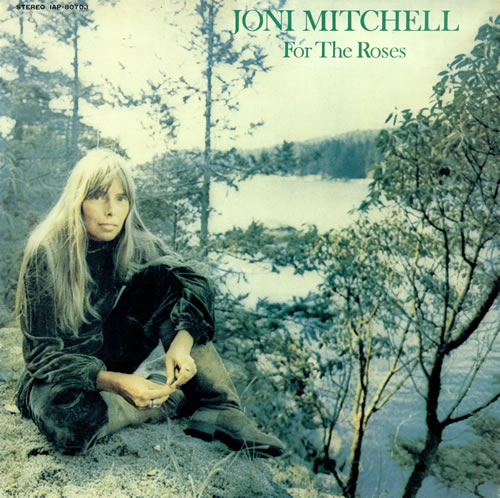
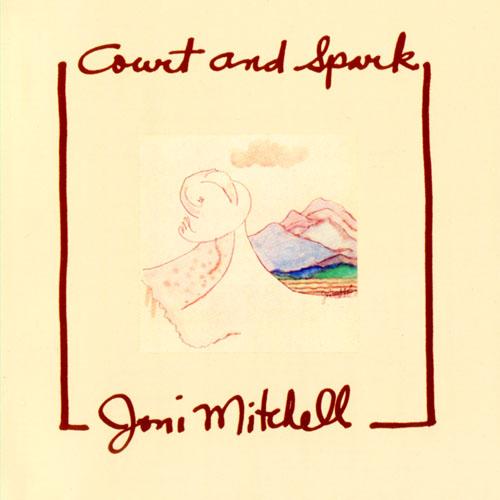
For the Roses, her fifth album, was released in October 1972, and included her first hit single, "You Turn Me On, I'm a Radio." Court and Spark followed in January 1974, and spawned two hit singles, "Free Man in Paris" and "Help Me," which became Joni's only Top 10 single when it peaked at number 7.
Miles of Aisles, a two-disk live album, was released in November 1974 and like Court and Spark also topped out at No. 2 on the Billboard chart. Joni had recorded
the album earlier in the year while on tour with Tom Scott's L.A. Express, a jazz-pop band that she had sought out to broaden her musical palette. The band included drummer John Guerin, who became another of her lovers.
The Hissing of Summer Lawns, an allusion to the sprinklers on the lawns of the mansions in her Bel Air neighborhood, was released in November 1975 and climbed to No. 4, but was panned and unfairly so. Joni was starting to move away from her young womanish confessionalism and the critics were having trouble keeping up.
* * * * *
In early 1976, Joni traveled cross country to Maine with friends. Donning a red wig and renaming herself "Charlene Latimer," she drove back to L.A. alone in a rented Mercedes convertible, writing most of the songs for Hejira as she traveled.
This ninth and most realized of her 27 albums -- with its riot of open tunings, complex harmonies, tensions and releases and stunning visual imagery, as well
as the eclectic electric bass guitar stylings of Jaco Pastorious -- was released in November 1976 and broke the Top 20.
An "hejira" is a flight from danger and the album's
song cycle was drawn from her transcontinental odyssey amidst the celebration of the U.S.’s 200th birthday. Critics gratefully declared the album a return to form, but they missed a larger point
Weller writes:
The long trip seemed to highlight how out on a limb she'd chosen to climb. As with more than a few other women in their mid-thirties, the indecisiveness that had started as a temporary principled rebellion had become her life. Six years ago she'd journeyed through Europe – sleeping in Malta caves and Ibiza fincas – to shake off a relationship with Graham [Nash]. Now in shaking off John [Guerin], cold-water interstate rest rooms, blue motel rooms, and Winn-Dixie cold cuts formed the starker backdrop and sustenance for her advanced reflections.
In the summer of 1977, Joni began work on what would be her first studio double album and her most daring in that it was completely jazz based. When Don Juan's Reckless Daughter was released in December 1977, it received mixed reviews. Janet Maslin of The
New York Times dubbed it "Joni Mitchell's Reckless and Shapeless Daughter" and wrote that this "failure" showed that:
Mitchell appears bent on repudiating her own flair for popular songwriting, and on staking her claim to the kind of artistry that when it’s real doesn't need to announce itself so stridently.
Such reviews wounded Joni, who for all her determined independence wanted her fans to love her and the critics to appreciate her, but she plowed ahead and in late 1978 received a career- and life-altering call from Sue Graham Mingus, the wife of legendary jazz composer and bassist Charles Mingus.
Mingus, who was wheelchair bound and in the final stages of amyotrophic lateral sclerosis, had been so taken by Joni's foray into jazz that he wrote six melodies flatteringly titled "Joni I" to "Joni VI." Mingus' wife asked whether she would be interested in writing lyrics for them.
Joni composed the words for four of the pieces with Mingus before he died in January 1979 and finished
the other two later. She then recorded the album Mingus with a who's who of sidemen, including Pastorius, drummer Don Alias (her lover at the time), keyboard innovator Herbie Hancock and sax virtuoso Wayne Shorter.
Critics were befuddled – and generally critical -- after the album's November 1979 release, and it "only" reached No. 17. But Joni knew exactly what she was doing, telling Cameron Crowe in a Rolling Stone interview:
You have two options. You can stay the same and protect the formula that gave you your initial success. They're going to crucify you for staying the same. If you change, they're going to crucify you for changing. But staying the same is boring. And change is interesting. So of the two options, I'd rather be crucified for changing.
* * * * *I have nothing against Joni's later career, which abruptly if temporarily ended in an angry outburst in 2000 when she declared that what passed for commercial radio fare was slop (generally true) and she couldn't get a hearing (entirely true).
Not long after she unretired to record for the Starbucks chain label, but she had made a larger point: Eric Clapton could grow old and look old but remain "vital" in the eyes of critics, but Joni Mitchell was not allowed to do either and everything she did would be incessantly compared to her early work.
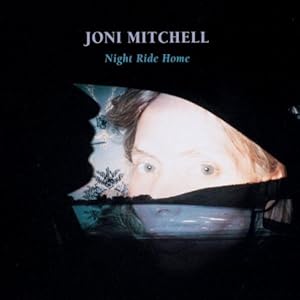
Except for a few albums, Night Ride Home (1991) and Turbulent Indigo (1994) chief among them, my head and heart remain happily stuck in the amazing creative burst that took the squeaky voiced girl from the plains of Saskatchewan through Song to a Seagull to the husky voiced chanteuse of Mingus.
At the end of the day, there is no compliment greater than to be called a "musician's musician," but what is so extraordinary about Joni is her songs are so powerful that early on musicians were drawn to them before she had even recorded them herself.
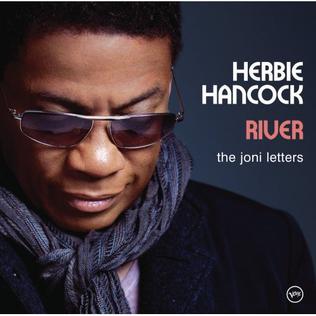
She is an ultimate musical category breaker, and artists as disparate as Tori Amos, Elvis Costello, Madonna, Bjork, Prince, Morrissey, and Counting Crows, which had a big hit with her "Big Yellow Taxi," to name but a few, have been moved and influenced by her. But River: The Joni Letters, a 2007 Herbie Hancock album covering nine of her songs that was a surprise Grammy winner, is to my ears the ultimate tribute.
To hear Norah Jones sing "Court and Spark" with the accompaniment of Hancock, Wayne Shorter and Dave Holland, as well as other sidemen, is to hear Joni all over again for the first time.
But it is Luciana Souza singing "Amelia" that best sums up Joni Mitchell for me:
The drone of flying engines
Is a song so wild and blue
It scrambles time and seasons if it gets through to you
Then your life becomes a travelogue
Of picture-postcard-charms
Amelia, it was just a false alarm

ALBUM COVERS (Top to bottom): Song to a Seagull (1968), Clouds (1969), Ladies of the Canyon (1970) For the Roses (1972), Court and Spark (1974), The Hissing of Summer Lawns (1975), Hejira (1976), Don Juan's Reckless Daughter (1977), Mingus (1979), Night Ride Home (1991), Turbulent Indigo (1994), The River: The Joni Letters (2007), Love Has Many Faces (2014).

In the last two-plus decades as the Republican Party's drift to the right morphed into a full-blown gallop and the party's base came to be dominated by Bible thumpers and angry white men -- and frequently Bible thumping angry white men -- the GOP has won only two of six presidential elections, one because the Supreme Court gave the Constitution the finger and the other because Republicans had perfected their fear machine message and the Democratic candidate was weak.
It is probable that Republicans will not halt their losing streak in 2016. This is less because the first joker out of the gate in the quadrennial clown car race known as the party's presidential primary is Ted Cruz, soon to be followed by Marco Rubio, than good old mathematics. While Cruz, Rubio and many other GOP stalwarts may insist global warming is a hoax, not even these junk science devotees can deny that despite Hillary Clinton's vulnerabilities, the probable Democratic standard bearer begins the 2016 race a mere 24 electoral votes shy of the 270 needed to win.
The Democrats have 246 electoral votes more or less in the bag: California (55), Connecticut (7), Delaware (3), District of Columbia (3), Hawaii (4), New Hampshire (4), Illinois (20), Maryland (10), Massachusetts (11), Maine (4), Minnesota (10), Michigan (16), New York (29), New Jersey (14), Oregon (7), Pennsylvania (20), Rhode Island (4), Vermont (3), Wisconsin (10) and Washington (12). Sure, you can quibble about a couple of these states, but the fact remains that the Democrats' traditional political base remains as solid as the Rock of Gibraltar and although the eventual Republican nominee will be a conservative in moderate drag like Jeb "Gator" Bush or Mike "We've Got a Perception Problem" Pence, the hardcore right-wing tail wagging this flea-infested dog helps insure that retaking the Oval Office will be illusory.
The conventional wisdom has it that another divisive cage match with Cruz, Rubio and perhaps Mike Huckabee, Chris Christie, Rick Perry, Scott Walker and, if there really is a God, the good doctor Ben Carson not unlike the 2012 Republican primary benefits Democrats generally and Clinton in particular. But whether the 2016 primary is another battle for the soul of the party, yada yada yada, methinks that whomever gets the nomination (more likely Jeb Bush than not) will need to have a well-oiled campaign machine in order to prevail at the party convention (July 16-21, 2016 in Cleveland), which should toughen him for the fall slugfest against Hillary, while voters (who have notoriously short attention spans) will be more focused on stuff that really matters.
This stuff includes the economy, which could be a winner for the Republican nominee if President Obama's impressive stewardship of the economic recovery necessitated by the (Not Jeb Bush) Bush Recession craps out. Then there are sure losers for the Republicans, including reproductive rights and racial and gender equity, same-sex marriage and immigration, as well as the inconvenient reality that the U.S. is becoming browner and blacker, which is to say less and less Republican.
But back to the cudgel-wielding Cruz, an egomaniac whose chief credentials are that he has an incurable case of Obama Derangement Syndrome, is widely loathed by his fellow U.S. senators, has repeatedly tried to shut down the U.S. government in actions bordering on the traitorous, and is unrelenting in trying to ram his religion and extremist views down everyone's throats to win brownie points with Tea Partiers and Evangelicals.
If having virtually no public sector experience is a requisite for becoming president, then the Canadian-born (shhh!) Cruz is a natural.
If embellishing on his credentials to drive the clown car by reading Dr. Seuss's classic Green Eggs and Ham and its "I do not like it" mantra while filibustering a Democratic move to block defunding Obamacare, then he'll fit right in at White House events like the annual Easter egg hunt.
If opposing net neutrality because it would be another example of "government tyranny," as he puts it, garners big buck donations from Comcast and Time Warner, then he's smarter than I have been willing to give him credit for.
And if leading opposition to Obama's eminently able surgeon general nominee amidst the ebola public-health crisis because the nominee once had the temerity to suggest that the carnage from gun violence is something of a public health crisis itself, his tenure as a darling in the Fox News echo chamber is guaranteed.
Never mind that "it would take a coordinated series of 16 or so lightning strikes to make Ted Cruz the 45th president of the United States," as my friend Will Bunch puts it. Cruz is an idiot. No, make that a dangerous idiot.

There is a common denominator to the tributes that have poured in since the passing of Rick Chamberlain: Beyond his public face as a master trombonist, music teacher and jazz festival organizer, Rick gave selflessly to both those whom he loved and those he merely knew.
In my own case as jazz fan and journalist, Rick not only blew my socks off during many a Delaware Water Gap (Pa.) Celebration of the Arts performance and at the more intimate Deer Head Inn, he opened many doors for me when I set out to write a book about the life, times and unsolved 1981 murder of his dear friend, Eddie Joubert, the beloved owner of a Delaware Water Gap bar where Rick played as a member of the psychedelic-tinged rock band Asparagus Sunshine and sat in at after-hours jams.
From the Foreword to The Bottom of the Fox: A True Story of Love, Devotion and Cold-Blooded Murder:
"Back in the day, Eddie and two musicians -- trombonist Rick Chamberlain and alto saxophonist Phil Woods -- were known as the 'Unholy Three.' They came up with the idea of the jazz festival as a way to raise money to fix the Gap's decrepit sewer system on a boozy night on the front porch of the Deer Head Inn jazz club in 1978. Chamberlain, who Eddie later talked into successfully running for Gap village council, which in turn jumpstarted a lifelong dedication to community service, was eager to talk to me.
"That was such a formative part of our lives," is how Rick put it.
Long story short, some people were reluctant "to open their Eddie boxes and be interviewed" two decades after the murder, as I put it. That was until word got around that Rick had talked to me -- several times, in fact. This was a de facto seal of approval for my mission -- to remember Eddie and shame a Poconos law-enforcement that could care less about a heinous crime that had robbed the Gap of so special a man -- for the tight-knit jazz, arts and crafts and Vietnam veteran communities of which Eddie had been so supportive, and the book took off from there. Five years on, it remains in print and sells steadily if not spectacularly.
DEBORAH OLSON, BOB DOROUGH, THE AUTHOR AND RICK AT THE 2010 COTA
Rick, who was 63, never made a big deal -- or any kind of deal, for that matter -- about all that he gave, and some of his more noble kindnesses and philanthropic gestures are know only to the recipients and a few others.
Rick finally succumbed to pancreatic cancer on March 27 at his Stroudsburg home with family and friends at his side. A memorial service is being planned.
He was a fighter to the end, and while his illness prevented him from taking his chair as principal trombonist for the New York City Ballet Orchestra for the first time in many years for the ballet's annual holiday production of the The Nutcracker at Lincoln Center, he continued to play, conduct and teach.
This included leading the Deer Head Inn Jazz Orchestra, an 18-piece ensemble of COTA All Stars that will be playing on Monday night for the first time without the peerless Rick Chamberlain.