Thursday, April 06, 2006

Iraq I: The War Is a Disaster. You Can Book It

The trickle of books harshly critical of the Bush administration's decision to invade Iraq and the disasterous aftermath has become a flood. These aren't books written by flame-throwing leftie provocateurs; they're by people who know what they're talking about.

In the last few weeks alone, there has been:
* "Cobra II" by Michael R. Gordon, the New York Times' chief military correspondent, and Bernard E. Trainor, a retired Marine Corps lieutenant general.

"Cobra II" is a powerful indictment of the multiple failures of Defense Secretary Rumself and his Pentagon flunkies based on extensive interviews with battlefield commanders and others in the know.

* "Boys of '67: From Vietnam to Iraq, the Extraordinary Story of a Few Good Men" by Anthony Zinni, a retired Marine Corps general who once commanded all U.S. troops in the Middle East.

Zinni is harshly critical of the entire Iraq adventure and bluntly calls for Rumsfeld's ouster.
Peggy Noonan, the conservative but independent minded Wall Street Journal op-ed columnist, is reading "Cobra II" and is in a conclusion drawing mood:

The Iraq story is not over. We are there. We must give our troops everything they need, and remain cleaved to them in gratitude and loyalty. More will be written, more books and commentaries, and memoirs, too. For now, from me, two thoughts that have bubbled up from the national conversation this week.

The first is optimistic. Our troops in Iraq are the best of us: brave young men and women willing to put themselves in harm's way for their country. But they are by and large something else: very good, and kind, and generous human beings. Every day for three years they have, as part of their mission and in their off hours, been interacting with Iraqi kids and young people. Those kids, those young people, having been exposed to who Americans are--their kindness, their helpfulness, their humor and good nature--will never forget it.

Will this have implications for the future? Yes, I do believe it will. After World War II, half of Europe had been defeated by America, bombed by it. And yet America had the broad support and affection of Western Europe in the crucial quarter century after that war, in part because of efforts such as the Marshall Plan, but also because of exposure, both prewar and postwar, to American GIs. Europeans came to know who Americans were. American leaders and diplomats did plenty to help America's standing, but in the end the glory went, I think, to the GI Joes, and some Janes too, who won and occupied with American grace.

We will find, down the road, that many in Iraq will hold affection and respect for America because of the Americans they met and came to know in our armed forces in the first years of the 21st century. And this will have implications, and they will not be unhappy.

The second thought is less happy. Tony Zinni was against the Iraq war before it occurred, opposes it now, has written about it. Fine. But the history recounted in "Cobra II," and the testimony of Gen. Zinni, suggests a lot of generals--a lot--were against the war in the run-up, for reasons that were many and serious. If this is correct it begs questions: Did they feel they could not speak? Why? What dynamics went into the decision? Or did they speak and we didn't hear, or didn't weigh what was said seriously enough? Did they speak inside? To what degree did the inside listen? Or were the generals and colonels, in fact, split? Were the generals more supportive than is now being suggested?

What really happened? I suspect books will be written on this too. I suspect we are all going to learn a lot, and some of it may be quite painful.

.

Iraq II: By the Numbers

Myelectionanalysis, by way of Wretchard at Belmont Club, has an interesting (if inconclusive) look at some Iraq war numbers:

81, 76, 50, 49, 43, 25

What are these numbers? This week’s Powerball winners? . . . No, they’re the number of troops that have died in hostile actions in Iraq for each of the past six months. That last number represents the lowest level of troop deaths in a year, and second-lowest in two years.

But it must be that the insurgency is turning their assault on Iraqi military and police, who are increasingly taking up the slack, right? 215, 176, 193, 189, 158, 193 (and the three months before that were 304, 282, 233).

Okay, okay, so insurgents aren’t engaging us; they’re turning increasingly to car bombs then, right? 70, 70, 70, 68, 30, 30.

Civilians then. They’re just garroting poor civilians. 527, 826, 532, 732, 950, 446 (upper bound, two months before that were 2,489 and 1,129).

My point here is not that everything is peachy in Iraq. It isn’t. My point isn’t that the insurgency is in its last throes. It isn’t. My point here isn’t even to argue that we’re winning. I’m at best cautiously-pessimistic-to-neutral about how things are going there. . . . My only point is that . . . I was unequivocally shocked when I saw this. Completely the opposite of what I’d expected. My non-scientific sample of three friends, all of whom are considerably more bullish about the prospects in Iraq than I am, revealed three people similarly surprised by these numbers.

This is what Wretchard himself has to say:

[C]asualty numbers are down not just for Americans but for Iraqis and civilians too. . . . But the question is what does it mean? One possibility is that the "increasingly confident" insurgency reported by the International Crisis Group is giving America one last respite before unleashing hell and finally driving the US from Iraq. The other possibility is that the enemy, unable to defeat the US military in the field, has embarked on a strategy Amir Taheri called "Waiting Out Bush". Or in Belmont Clubese, the enemy having lost the military war now hopes to win the political war. Taheri says that many Arab capitals are simply waiting for a new administration to ride to their rescue. The trick is simply to "wait out Bush".

How the U.S. Lost Latin America

The Dear Friend and Conscience (DF&C) spent five weeks in South and Central America recently and returned home saddened over a disaffection for the U.S. that ranged from feelings of abandonment to anger that she found nearly everywhere she went.

President Bush came to office in 2001 declaring that Latin America would be a priority, but it has been anything but. It is safe to say that five years on, relations between the U.S. and Latin American countries are the worst in years.

Notes the BBC's Gavin Esler in a news analysis:

Virtually anyone paying attention to events in Venezuela and Nicaragua in the north to Peru and Bolivia further south, plus in different ways Mexico, Argentina and Brazil, comes to the same conclusion: there is a wave of profound anti-American feeling stretching from the Texas border to the Antarctic.

And almost everyone believes it will get worse.

. . . For his part, President Bush even suggested that the United States had no more important ally than . . . wait for it . . .Mexico.

None of that survived the attacks of 9/11.

Mr Bush launched his War on Terror and re-discovered the usefulness of allies like Britain.

While Washington's attention turned to al-Qaeda, the Taleban, Iraq and now Iran, in country after county in Latin America voters chose governments of the left, sometimes the implacably "anti-gringo" left, loudly out of sympathy with George Bush's vision of the world, and reflecting a continent with the world's greatest gulf between rich and poor.

Esler notes that in Nicaragua, a young Sandinista revolutionary by the name of Daniel Ortega (see Time magazine cover) is back and may be re-elected president:

Can you imagine it? The man who survived CIA plots and Contra death squads, who relinquished power peacefully to Washington's candidate, Violeta Chamorro, sweeping back into the Nicaraguan presidency?

It will be a huge embarrassment for George Bush junior, a symbol of everything that has gone wrong with American foreign policy in the hemisphere. And guess who predicted it would go wrong? Violeta Chamorro herself.

The night before her election victory over Mr Ortega I was invited to dinner at the walled compound of Mrs Chamorro's house in Managua. She told me that Washington politicians could always find money for wars in Latin America - but rarely for peace in Latin America.

Catastrophic Profits For Insurers

Given Hurricane Katrina and the other major storms last year, you would think that insurance companies would be on their knees.

Well, think again.

The Los Angeles Times reports the companies that provide Americans with homeowners and auto insurance made a record $44.8-billion in profits last year, an 18.7 percent increase over 2004.

Insurance executives describe the windfall as a fluke, the product of gains in other lines of insurance besides homeowners and a very good year for their investments.

Sounds like a rationale that you'd hear from the oil industry, which also made record profits last year despite offshore drilling, refinery and pipeline shutdowns because of Katrina and other storms.

The Paradox of King George Bush

Here’s a question that has long puzzled me:

From everything we know about King George Bush, confirmed time and again during his five-year reign, he is a mediocrity of the first water. Detail averse, unable to think deeply, short attention span, and so on and so forth. Yet he still generates intense loyalty in people.

Why?

When Kevin Drum at Washington Monthly recently posed that question, some of the answers he received shed light on this apparent paradox. Herewith a sampling:
It's not like he's surrounded himself with people who are really all that much smarter than he is. These people have learned to never, ever bite the hand that feeds them.

The White House is like a frat house. Bush is the older frat boy and his advisers follow his lead, because in their eyes, he's cool. One day they'll leave and look back wondering why the hell they let that dimwit give them wedgies all the damn time. Until then, we all suffer.

Our presidents are human beings, not gods. Most have had incredible quirks and failings of a myriad sort. Bush is no different than the others.

You know the saying: First-rate leaders hire first-rate staffs; second-rate leaders hire third-rate staffs.

Is it precisely because Bush is such an empty vessel of a man, such a blank slate, that his supporters can ascribe whatever virtues they desire onto him?

Is it because he has no real stable personality of his own that his sycophants can see whatever they want to in him?

There have been a number of former Bush officials who have trashed the president after leaving from Paul O'Neil and Richard Clarke to Andrew Natios recently. For some reason these people drop down the memory hole and the MSM goes back to the "fiercely loyal" meme.

I hate to always bring up Nixon, but what choice does this administration give me? The Nixon White House was staffed by people who throve on a siege mentality. A shared, insane ideology and the slobbering pursuit of wealth and power may be what brought the Bush inner circle together, but dehumanizing all political and civic opponents is what cements it. They want a constant state of war, both outside and inside the country.

I know that Bush hails from a powerful dynasty, but I think the man is so obviously mediocre and untalented that there's a very strong element of underdog worship in the phenomenon of Dubya loyalty.

It must tickle someone like Karl Rove -- surely a geek who was picked on mercilessly in high school or a loser who could never get a date with the hot cheerleader -- silly pink to be able to watch his boss best all them high achieving Ivy League types who populate liberal circles. Bush is a proxy for a lot of conservative anger at our powerful liberal culture and the accompanying desire for revenge.

It's a mystery we've been trying to solve for ages, from little Corsican corporals, to Austrian paperhangers, to Cuban baseball rejects. The cult of personality is a powerful thing . . . Rationality goes out the window when you're blinded by fear. Fear of the black man, fear of the empowered woman, fear of the empowered poor, fear of the Muslim . . .

Life is full of ironies. The Chinese Communist Party leads the fastest growing, least ethical, Capitalist country. A C-student leads some of the smartest neo-cons around. And Bill Clinton, who bonks younger women in affairs and uses them as ashtrays, is still one of the most popular figures with American women.
And finally, these two responses:
Just remember, Abraham Lincoln failed at every job he had before he was President. Those who are afraid to fail never succeed. I knew Abraham Lincoln.

I worked with Abraham Lincoln. Abraham Lincoln was a friend of mine. And George W. Bush, sir, is no Abraham Lincoln.

Wednesday, April 05, 2006

Quote du Jour

From an editorial in today's Wall Street Journal:

Tom DeLay's decision to resign from Congress removes one large Republican liability this election year, but it hardly ends the party's political vulnerability. One pressing question is whether the GOP majority is going to use the few productive weeks it has left to establish a 2006 record and 2007 agenda that are worthy of re-election.

Recent evidence is not reassuring. GOP leaders seem determined to avoid any meaningful legislative fights, lest their own internal fissures show. Instead, they're promising to make the election a "choice"--rather than a referendum on their own governance--and thus mobilize voters by claiming that Democrats would be worse: that they'd raise taxes, impeach President Bush and cut and run from Iraq if they win. And as a desperation strategy, fear does sometimes work.

On the other hand, the biggest Republican problem now is the demoralization of their own voters. Their lack of meaningful achievements this Congress (beyond the two Supreme Court Justices), all of their spending, and troubles in Iraq have left conservative voters wondering what the point is to voting for the GOP. If Republicans want their supporters to show up on election day, they'll need more of a message than wearing a "Speaker Nancy Pelosi" fright mask.

Legal Document du Jour

The ever informative SCOTUSblog has put up a link to the form the federal court jury used in returning a guilty verdict at the sentencing trial of Zacarias Moussaoui, the so-called 20th 9/11 hijacker. The jury will use a second form to decide for or against the death sentence.

'Walk Away DeLay' by the Right Banke

My pal Will Bunch over at Attytood has penned these clever lyrics, which are to be sung to "Walk Away, Renee" in honor of a certain disgraced Texas congressman.

All together now . . .

And when I see the cash that flowed one way
The tribes we used to rip off . . . every day

Just walk away DeLay
They weren’t gonna vote for you back home
The empty K Street office suites are not the same
Jack’s not to blame

From deep inside the tears you’re forced to cry
Now when you grab a meal . . . you’ll have to buy

Just walk away DeLay
And hope a defense contractor buys your home
Now as a plane takes off for Scotland’s finest links
Not there . . . it stinks

Your name is still atop a . . . kids’ charity
Now we all know its aid was . . . meant for thee

Just walk away DeLay
And pray federal agents aren’t at your home
Now as your aides have flipped . . . against your crooked scam
They’ve burst your dam

Just walk away DeLay
The right wing won’t follow you back home
An empty cell awaits . . . to end your life of fame
Who will you blame?

Gene Pitney (1941-2006)

Singer Gene Pitney, whose ballad "Town Without Pity" was one of my faves as a teenager, died in Cardiff, Wales today while on a tour of Great Britain.

The 65-year-old American star was found dead in his hotel room. Police said the death was not being treated as suspicious.

Pitney's melodramatic vocal stylings bridged the gap between 1950s pop and 1960s rock 'n' roll.

His 40-year career included several big hits in addition to "Town Without Pity," including "It Hurts to Be in Love," "Every Breath I Take," "Only Love Can Break a Heart," "I'm Gonna Be Strong" and his biggest, "24 Hours From Tulsa."

Pitney was unfairly considered a lightweight by some critics, but his influence is writ large in several areas.

"Mecca," his 1963 hit, was a precursor to psychedelic music because of Pitney's use of Indian musical influences, while "(The Man Who Shot) Liberty Valance" went a long way toward bringing country music into the pop mainstream.

Like many other American artists, Pitney was eclipsed at home by the British invasion, but remained popular in the U.K. and Europe.

His songs have been recorded by other stars -- "Hello Mary Lou" by Ricky Nelson, "Today's Teardrops" by Roy Orbison, and "Rubber Ball" by Bobby Vee. Pintney also wrote the Crystals smash hit "He's a Rebel."

Still Rudderless at FEMA

The ineptness of the Bush administration when it comes to fundamentals like homeland security continues to stun and amaze.

Lest anyone need reminding, there may be no more pertinent example than the Federal Emergency Managment Agency (FEMA), which won praise for its response to hurricanes, earthquakes and other natural disasters during the Clinton years.

The Bush administration, however, was unable to leave well enough alone. The White House installed a series of political hacks to run FEMA who were disasters themselves because they had no emergency relief experience and folded the cabinet-level agency into the huge Department of Homeland Security, where it was an unwelcome stepchild that no one wanted or quite knew what to do with.

The consequences of putting politics ahead of prudence were on display for all the world to see when Hurricane Katrina tore through New Orleans and the Gulf Coast last August. While local and state officials contributed their share of problems, FEMA showed itself to be profoundly incapable of doing anything right and shredded the Bush administration mantra that the U.S. was prepared for another 9/11.

The start of 2006 hurricane season is only weeks away and the experts say it is likely to be another humdinger.

A reasonable person might assume that the White House has learned from the painful lesson of Katrina if only because President Bush took such a licking in public-opinion polls -- and in fact has never rebounded to pre-Katrina levels.

Well, guess again.

The New York Times reports that a months long nationwide search for a new FEMA director has been a bust because each and every qualified emergency response expert contacted -- the best in their field -- turned down the job.

The reason? None believe that the administration is serious about fixing FEMA.

It's easy to see why.

There still is no plan for reforming FEMA. Eleven of its 30 most senior jobs are being filled on an acting basis, including the directors of disaster relief operations. Most embarrassingly, the administration is now stuck with making the current acting director permanent.

That sends a most disturbing message that speaks volumes about the presidency of George Walker Bush: A vitally important government department in the post-9/11 world is being run by the only person the White House could find who was willing to take it on.

SHE CARES. SO SHOULD YOU.

Bri is a grassroots activist who, as she puts it, "spent four years soaking up the culture of the Crescent City" while going to college there and now wants to give something back.

She believes in the power of grassroots groups to effect change and soon will be returning to New Orleans to help try to make that happen.

Please visit her blog -- Pursuing Tzedek -- and give her your support.

MORE HOMELAND INSECURITY

Speaking of the Department of Homeland Security, its deputy press secretary has been arrested on charges that he used the Internet to seduce an undercover Florida sheriff's detective who he thought was a 14-year-old girl.

Disgusting details here.

Guest Blog: Country Pudding

Country Bumpkin is a frequent visitor to Kiko's House from New Zealand. He resides in the lovely Wairarapa region at the foot of the Tararua Mountains on the North Island, which was one of the shooting locations for the magnificent recreation of Tolkein's Middle Earth for the "The Lord of the Rings" film trilogy.

I am passionately fond of mushy pudding, filled to the brim with eggs, milk, vanilla beans and sugar. Rice, tapioca, sago, bread -- any or all of the above. And not to forget plain old custard. I will happily dispense with first and second courses just to get to the pudding, and no restaurant has ever had bread pudding on its menu without selling a helping to me.

But not to my wife. Mention rice pudding to her and she will screw up her face, put her finger down her throat and make retching noises -- she calls it a psychological reaction to an overdose of this sublime food from a childhood which was subject to disciplines not often reported in today's society. "Eat your pudding! There are millions of people in China who would kill for food like that!" (They would, the way I make it.)

Imagine my surprise, if you can, when I proposed (for maybe the thousandth time) yesterday that I whip up a bread pudding for dessert, and my wife said yes! So I did, and I sprinkled raisins and slivered almonds through it, and in this simple fashion, after 47 years of marriage, we broke our duck. (Overseas correspondents not familiar with the game of cricket may care to know that this means our score advanced from zero.)

Oh, bliss . . .

We are into the Indian summer now, and of course the grass has begun to grow again -- as have the mushrooms -- after the summer recess. And very well it looks too. March was cold, and we actually lit the fire on several days -- a most unusual thing to do in recent years as the climate warms. It was a good test for our freshly filled woodshed, because we seem to have acquired a stock of exceptionally good firewood, an uncertain business at the best of times. This year's supply burns hot and slowly, the best of all combinations.

While all this is going on, the trees are changing colour and dropping their leaves, such that a big vacuum cleaner comes along the street every morning and sucks them up, lest it rain and the drains can't take the water away. It's all absolutely beautiful. But a bit messy.

Last weekend we went to the French Fair at the beautiful Tauherenikau Racecourse, near Featherston. The horse racing industry in New Zealand has fallen on hard times in recent years, and this can be seen in the rather old-fashioned and run-down look of so many race course buildings. Tauherenikau stands out nevertheless, because its public areas are cleared out of old native bush, which provides a wonderful dappled light and shelter from the heat.

The Wairarapa is a popular venue for fairs, and the goods and food and crafts on sale are brought to them by petit bourgeois traders from all over the country. Of them all -- the fairs, not the traders -- the biggest and most famous are held in Martinborough in February and March, where easily 25,000 people mill around buying hand-crafted wooden bowls and eating ice cream. But I have a feeling the Tauherenikau event, held on the first weekend in April, might soon outshine the older fetes. All the traders are dressed in black berets, red scarves and white polo shirts with horizontal black stripes, there is a "gendarme" directing the traffic -- including bus loads of pensioners -- and although they all speak with Kiwi accents (aaaarghhh!) the chanteuse who accompanied herself on the accordion (while her boyfriend played bass) all help to alter the reality for a little while. There was a cracking good jazz trio, a man with a wood-fired pizza oven on the back of his ute making beautifully crunchy disks covered with mozzarella, tomato and mushrooms, and others were selling more varieties of herbal hand cream than you can shake a stick at.

Great fun! And when you leave the trees and walk up a little rise overlooking the race course itself, the big sky stretches out to the horizon.

I've been writing these Country Life newsletters for three and a half years now, yet not once have I written (so far as I recall) about life on the heartland itself -- and I mean the real heartland now -- itself. But today I lunched with a native of the Wairarapa who farms dairy cows and sheep, and whose family connections sell huge Swedish and American farm machinery in serious quantities, thereby helping to make the land more and more productive.

He took me on a tour of his extensive holdings, which stretch for many kilometres in every direction, on some of the best land in the valley. For the first time since I was a small boy, I stood in a milking shed. The cows stand on a turntable, a man fits the milking machine to their teats, and as the stand turns and a gap opens, another cow voluntarily, nay eagerly, steps up to the plate. Once the milking is finished, the machine drops the suction cups, helped by the cow which detects the drop in vacuum and kicks the cups free, then turns and walks out to the field to start eating again. The body heat from the milk is used to warm the water used to clean the milking shed, and in the exchange of heat the milk is chilled to storage temperature, ready to be collected and taken to the factory for processing.

Water is always a problem in this drought-prone valley, so many farms have irrigation systems. My farmer friend drills for underground water, and has great success in finding it. His technique is to hire the skills of a local water-diviner!

When I was a boy in a milking shed, water diviners were to be found. But not the turntables, computers, valves, machine-readable ear tags, pumps and sensors which make it possible for one or two farm hands to milk 500 beasts or more, twice a day.

If you think I was impressed, you're right.

Devil's Dictionary IX

Here's a ninth entry from Ambrose Bierce’s “The Devil’s Dictionary.”

If you missed my earlier posts, Bierce (1842-1914) was a brilliant but underappreciated American author and journalist who had a long and tumultuous releationship with press baron William Randolph Hearst, and was a misanthrope possibly without peer.

TAIL
Noun. The part of an animal's spine that has transcended its natural limitations to set up an independent existence in a world of its own. Excepting in its foetal state, Man is without a tail, a privation of which he attests an hereditary and uneasy consciousness by the coat-skirt of the male and the train of the female, and by a marked tendency to ornament that part of his attire where the tail should be, and indubitably once was. This tendency is most observable in the female of the species, in whom the ancestral sense is strong and persistent. The tailed men described by Lord Monboddo are now generally regarded as a product of an imagination unusually susceptible to influences generated in the golden age of our pithecan past.

Tuesday, April 04, 2006

Update on General Motors: Still Clueless

The board of General Motors has expressed support for Rick Wagoner, the ailing auto giant's embattled chief executive, as it approved shedding yet another profitable arm to stay afloat -- the General Motors Acceptance Corporation -- for a cool $7.4 billion.

Auto analysts said that the board's first public comment on Wagoner since a spate of bad news did not constitute an unconditional backing. Good damned thing!

Because there were a lot of technical problems out in the old blogosphere on March 31, I'm republishing my own take on the sorry state of The General from that date.

* * * * *

GENERAL MOTORS: 30 YEARS ON AND STILL CLUELESS
I trace the beginning of General Motors’ downturn from innovative colossus to the maker of boring rental cars that it is today back to 1976 when a peppy little import called the Honda Accord first arrived in the U.S.

I trace the fact that GM is nearly as clueless today as it was in 1976 back to 1992, when Rick Wagoner, then GM’s 39-year-old chief financial officer, was promoted and given orders to shake up the moribund giant.

I believe that the only way that GM can be revived is for Wagoner, GM's president and CEO, to be fired. Now.

* * * * *

The 1976 Accord had just everything that the GM cars of that era didn’t.

It was attractive, albeit in a cute sort of way. It was larger on the inside than it appeared from the outside, not the other way around. It had a rear hatch that opened to a collapsible back seat, offering lots of storage space. It handled well, had some oomph and was economical, which was no small thing arriving as it did between the twin 1970s oil crises. A practical friend who had owned GM cars forever bought a silver '76 Accord and was hooked. I drove it and was hooked, too.

GM’s response to the Accord and successive waves of hot selling offerings from Honda and later Toyota and Nissan (nee Datsun) was to continue churning out formulaicly unattractive and uneconomical cars of dubious quality. In fact, GM’s only direct response to the so-called Japanese Invasion was an abomination called the Chevette.

The General’s fortunes briefly improved after Wagoner took over and GM's share price soared to a record $90. But beneath the gloss the same fundamental problems persisted, eating into the huge corporation like rust spreading through the underbody of a Cadillac Coupe de Ville.

These problems included overcapacity – too many assembly plants and not enough orders -- and except for 1998, when there was a seven-week strike, sweetheart contracts with the United Auto Workers union.

But the biggest problem was that Wagoner’s GM was coasting along with that same tired product line as much of the rest of the automotive world was stealing a march on it with attractive and innovative products.

One GM brand was virtually undistinguishable from another. Calls to cut back on the duplication of models between brands and to even fold the lesser selling brands went unheeded until Oldsmobile was belatedly put out of its misery in 2004. Most ominously for GM, Japanese automakers were opening U.S. plants and turning out cars (and later small trucks) that were as well made as those at their vaunted home plants while GM’s U.S. plants continued to produce poorly made vehicles.

In 1992, the year Wagoner took over, GM sold 35 percent of all cars sold in the U.S. Today it sells 29 percent. Last year it suffered its biggest loss -- recently adjusted upward by $2 billion to $10.6 billion after a suspicious so-called bookkeeping error was discovered -- since the Great Depression. And, earlier this month said that it is inviting its heart and soul -- its 113,000 hourly workers -- to take a hike through incentives of up to $140,000 apiece. It is increasingly difficult to see how Chapter 11 bankruptcy can be avoided as Toyota, which already has overtaken Ford as the No. 2 worldwide seller, sets its sights on the General.

The question is not whether Toyota will become top dog, but when.

* * * * *

Hindsight being what it is, it’s easy now to see that Wagoner was the wrong choice to turn GM around. Wall Street knows that. The car dudes who write for Motor Trend and Automobile know that. Consumers know that. Wagoner and the GM board just happen to be the last people to know that.

Wagoner came up through GM’s financial division rather than manufacturing or sales, which may explain why he has been slow to recognize virtually every major automotive trend that has occurred on his watch.

These trends include minivans, smaller SUVs (Wagoner bought the Hummer brand just as the mega-SUV bubble was bursting) and an increased environmental awareness. GM has been ridiculously slow to embrace now popular gas-electric hybrid vehicles. It has no hybrids in showrooms today, while Toyota-Lexus has 12 models, including the Lexus GS450h, a $70,000 green sports luxury machine. Toyota-Lexus will soon have 20.

GM has survived because it still makes a heck of a lot of cars -- and trucks. It just doesn’t make money. (Its ossified dealer network is in even worse shape than the mother ship, but that's another story.)

In flailing around for a way out of its torpor, GM has become addicted to big rebates and zero-interest financing plans. Things got so bad last spring that it offered deep employee discounts to the general public. Sales perked up, but plummeted when the discounts ended. GM even ran a national ad campaign apologizing for its lousy performance and promised a return to the glory years. The background music was the sound of my GM-proud father spinning in his grave.

There have been successes on Wagoner's watch, but I can count only three of consequence.

He has cut costs and manufacturing capacity. Whoopie! He also has encouraged the near-death Cadillac division to shed its Geritol image. It now caters to the Led Zeppelin crowd and offers a line of trendy and well-made models, which while not my cup of tea, show that there’s life yet in the General.

But Cadillac is a niche brand and GM has yet to offer a mainstream success remotely approaching the VW Passat or Toyota Camry, which is the best selling car in America. Or the still hot selling Honda Accord. (I bought my mother an Accord in the mid-1990s with the money she got from selling her GM stock. Ha!)

No, make that only two successes on Wagoner's watch.

After successfully nurturing Saturn as the un-GM brand, Wagoner has allowed the once innovative spinoff to be dumbed down into the rest of the corporation. Saturn sales have tanked.

At this point, it's not a matter of General Motors emerging from its long self-inflicted nightmare smaller and leaner. It's a matter of surviving, which makes bankruptcy actually look pretty good since Wagoner is pinning GM's hopes on, of all things, a new line of big SUVs like the Cadillac Escalade and ChevyTahoe.

Wagoner has had 14 years to fix GM’s problems. He has only added to them, and the proof is that it still makes an enormous amount of crap.

It’s time to go, Rick. And don’t let the door hit you in the ass on the way out.

Oh, by the way, GM’s share price closed at $22.75 yesterday.

Quote du Jour

Dahlia Lithwick in a Slate commentary:
Hand it to Zacarias Moussaoui, who managed to snatch defeat from the jaws of victory with his fantastical eleventh-hour trial testimony last week about a never-before-mentioned fifth 9/11 airplane; the one that he would apparently have co-piloted with Richard Reid and flown into the White House. In a trial featuring some of the most spectacular episodes of government overreaching and misconduct we will ever see, Moussaoui managed to persuade the jurors that he was a key figure in the 9/11 attacks—even though he was in jail at the time and had always claimed before that Sept. 11 was "not my conspiracy."

Iraq: The N.Y. Times Blows It Yet Again

The error-prone New York Times reported last week that 30 beheaded bodies had been found in and near Baghdad. When that reported turned out to be inaccurate, the Times ran a "stealth" correction deep in a marginally related story, stating that
Earlier reports of 30 beheaded bodies found in that area were wrong, [an] Interior Ministry official said.
Bad. Very bad.

(Hat tip to The Mudville Gazette.)

Tom DeLay: It's Was All About Money and Power

America is a better place today with the news that Tom "The Hammer" DeLay is dropping out of politics.

As Kiko's House noted just yesterday, the noose is tightening around the once influential Texas Republican's neck as investigators close in on him. Five key aides and close associates, most recently his own deputy chief of staff, have copped guilty pleas to felonies stemming from investigations into illegal lobbying activities and money laundering.

DeLay's successor as House majority leader, John Boehner, praised The Hammer as a man of "integrity and honor."

That is bullsh*t, of course, as even an ethically impaired idiot like Boehner knows since it was DeLay's utter lack of both that got him his job.

Let's be real clear that this is not a partisan thing. DeLay just happened to be an immensely powerful Republican at a time when the GOP had an iron grip on Washington. That grip finally is diminishing because of the mess he and the right-wing zealots in his party have made of things. The Democrats are capable of being just as bad and may well be when they're back in control.

For his part, DeLay said he was "very much at peace" with his decision, which had followed "months of prayer and contemplation" and was based on is belief that the November election should be a referendum on Republican values and not himself.

Left unsaid was that the decision had more to do with:
* What DeLay's lawyers are telling him about his criminal culpability. Disgraced super lobbyist Jack Abramoff already has ratted out DeLay to a prosecutorial task force and his four other plea-copping pals are likely to do so, too. Meanwhile, he already faces trial on money laundering charges in a Texas court later this year.

* The likelihood that DeLay's once loyal constituents in Sugarland, a Houston suburb, would vote him out of office come November because of their disgust with his behavior and weariness over the embarrassment and ridicule that he has brought on their community. (DeLay, in fact, says he's changing his official residence to his second home in Virginia.)

* The Democrats losing a very big target in labeling the opposition as corrupt, which they will do early and often in mid-term election campaigning.
Apologies may come later, perhaps in a courtroom when that noose tightens further around DeLay's neck.

But for the time being, he is unrepentent and probably unaware of the destructiveness of the partisan money machine he so methodically built and ruthlessly ran like a Mafia don. Not to mention the harm that he has done to American politics, which certainly is a brake on the jubilation that I might otherwise feel.

To the very end, it was all about money and power.

THE END OF AN ERROR

The ubiquitous Glenn Reynolds had this to say about DeLay in The Guardian:

DeLay . . . is under investigation on charges of campaign finance violations, but I'm happy to see him leave for other reasons: He was the architect of the Republicans' "K Street strategy" - a program of incorporating lobbyists and interest groups into the process of governance - that has been disastrous for Republican ideals.

DeLay's defenders say that the K Street strategy is merely a reprise of what Democrats have been doing for decades, and they have a point. But Democrats are supposed to be the party of Big Government. Republicans are not, and the K Street strategy has led to a serious abandonment of their principles. (DeLay lost me back before the scandals broke, when he pronounced, inexplicably, that there was no fat left to cut in the federal budget.) I don't have much hope that DeLay's departure will do much tug the GOP back toward its principles, but it can't hurt.

EVIL OR ARROGANT?

DeLay has been accused of being evil, but as a guy who never played by the rules, isn't arrogant a better description?

I myself believe that the "evil" moniker is way overused in these contentious times and reserve it for only special cases. Come to think of it, with Saddam Hussein in prison and Solobodan Milosevic dead, there's only one man much in the news who has a lot of power to do evil who qualifies as such: Vice President Cheney.

Anyhow, there's a spirited evil DeLay vs. arrogant DeLay discusison going on at a Washington Monthly forum Check it out here.

CYNTHIA McKINNEY: A REAL CARD

Like I said, Democrats are just as capable of being dirty as Republicans. Take Rep. Cynthia McKinney of Georgia. Please!

McKinney is in the ethical crosshairs these days because Republican pols and the conservative media need a Democratic scapegoat.

(Speaking of the conservative media, The American Spectator, for example, posted an article headlined "Mount McKinney" today, but there was nary a peep about The Hammer, its one-time darling. The Daily Standard was more forthcoming in an article debunking the notion being trafficked by DeLay supporters that he was quitting for purely political reasons.)

In any event, the fiery McKinney certainly gives her critics plenty of ammunition.

Stories of McKinney misusing her office and taxpayer money are legion, and it was revealed this week that she paid soul music legend Isaac Hayes $1,000 to fly to Atlanta for the dedication of her new congressional home office. That is an illegal use of public money under House rules.

Last week, the six-term congresswoman scuffled with Capitol police when she tried to enter a House office building without an identifying pin label. McKinney's response was to play the gender and race cards by claiming that she was grabbed by an officer because she is a "female black congresswoman" and we all know how few of them there.

McKinney's latest exploits have prompted Atlanta area blogger Dignan to announce that he plans to run against her. He explains why at Dignan's 75 Year Plan:
Imagine having a representative in Congress who cares nothing about her constituents. Imagine your representative constantly being a target because of lunatic statements that would make great headlines at The Onion. Imagine having a virulent racist as your representative.

I don't have to imagine these things. I have to live with this each day.

Cynthia McKinney is not unfit for her job because she is liberal. There are plenty of liberal Democrats who serve their constituents well, even though I often disagree with their positions.

Cynthia McKinney is unfit for her job because she is a do-nothing demogogue whose apparent goal in life is self-promotion through race-baiting and conspiracy theories.

Monday, April 03, 2006

Quote du Jour

From an editorial in The Economist:
A common feature unites France's underclass rioters and the rebellious students, as well as the election of the far-right Jean-Marie Le Pen into the run-off of the 2002 presidential election. This is the failure of the French political class over the past 20 years to tell it straight: to explain to the electorate what is at stake, why France needs to adapt, and why change need not bring only discomfort. This failure has bred a political culture of reform by stealth, in which change is carried out with one hand and blamed on outside forces—usually globalisation, the European Union or America—while soothing words about protecting the French way are issued on the other. After a while, the credibility gap tears such a system apart. The French voted for Mr Le Pen in part because they were fed up with the stale mainstream political class. The banlieues exploded because unemployed minorities were fed up hearing that they did not belong. The students and trade unions are in revolt because they do not trust the government to protect them.

. . . The choice belongs to France. A bold effort at renewal that could unleash the best in the French? Or a stubborn defence of the existing order that will keep France a middling world power in economic decline? The latter would inspire neither admiration, nor terror, nor hatred, nor indifference, just pity.

Tom DeLay: He's Just a Babe in the Woods

Tom "The Hammer" DeLay's protestations that he's an innocent babe in that deep, dark woods of Republican corruption grow weaker by the confession.

No fewer than five key DeLay staffers and associates have now confessed to felonies. Josh Marshall has a list at Talking Points Memo.

Up to the Moment on the Dover C-5 Crash

As you may have seen or heard, one of those massive Air Force C-5 cargo planes crashed and broke apart while making an emergency landing this morning at Dover (Delaware) Air Force Base shortly after takeoff. All 17 crew members survived, most apparently without suffering serious injuries.

The crash of the C-5B (it is being widely and incorrectly reported as being an earlier C-5A model) is pertinent to me for three reasons:
First, I hitched rides on C-5As while bopping around the Far East many moons ago and can attest that they are indeed huge.

Second, Kiko's House is about 45 miles from Dover AFB and C-5s are a familiar sight as they begin their long-distance landing approaches. In fact, I saw one just yesterday afternoon as I worked outside. Actually, I heard it first because its engines have a distinctive high-pitched whirring sound.

Third, the ability of the Internet to bring the latest information to our doorsteps in a heartbeat never ceases to amaze me. There are some fascinating C-5 crash photos and considerable detail about what may have happened at a Web forum called AirDisaster.com
One of the things that makes the forum so interesting, at least for this novice, is that contributors seem to be a pretty expert lot and quickly deduced the possible cause of the crash: an emergency landing after an engine failure.

Meanwhile, local media are reporting that engine failure may have been due to birds and that the break-up into three pieces upon landing -- cockpit section, fuselage/wings and tail section -- may have been because the Kuwait-bound plane was fully loaded.

Update: Bush's War on Terror and Civil Liberties

The Bush administration, which fared poorly during oral arguments before the U.S. Supreme Court last week regarding the president's wartime detention powers, did somewhat better today as the top court rejected by a 6-3 margin an appeal filed by alleged terrorist Jose Padilla, the so-called "dirty bomber."

"Somewhat" is the operative word because the Supremes, in effect, sidestepped Padilla's challenge to President Bush's detention powers but refused to dismiss the case as moot.

Padilla, who originally was classified as an enemy combatant and held for three years without charges or access to a lawyer, now faces criminal charges in the civilian justice system, and the government had argued that the appeal over his indefinite detention was now pointless.

Nevertheless, three justices said the court should have agreed to hear the case anyway: Justices David H. Souter, Ruth Bader Ginsburg and Stephen Breyer.

An appeals court panel had all but called for the court to deal with the case, saying it was troubled by the Bush administration's change in legal strategy after holding Padilla for more than three years without charges.

SCOTUSblog interpreted the action thusly:

The decision was a victory for the Bush Administration in one significant sense: by not finding the case to be moot, the Court leaves intact a sweeping Fourth Circuit Court decision upholding the president's wartime power to seize an American inside the U.S. and detain him or her as a terrorist enemy, without charges and -- for an extended period -- without a lawyer. The Court, of course, took no position on whether that was the right result, since it denied review.

. . . The Administration was so eager to have the case out of the Supreme Court that it was willing to let the Fourth Circuit decision be erased, which would have been the result of a dismissal of the appeal on mootness grounds.

The victory for the government was not an unqualified one, however. The Court implied that Padilla has a legitimate concern that the government -- which repeatedly changed its handling of his status -- may again return him to military custody; it said that his case raised major issues -- including the role of the courts in dealing with presidential power, and it told all courts to stand ready to react quickly if the government again shifted Padilla's status or custody, in order to protect the writ of habeas corpus.. It even indicated that he would have a right to pursue a new appeal solely in the Supreme Court if his status were to change again. None of those comments would seem to be welcome to the Administration.

The handling of Padilla's case -- which has pinged and ponged as the Bush administration dredged up legal technicalities to keep it out of the Supreme Court -- has the regretably familiar earmarks of its serial mishandling of virtually every terrorist case that it has tried to prosecute.

Padilla is a former Chicago gang member who converted to Islam and was portrayed as the mastermind of a plot to explode a radioactive "dirty bomb" in an unidentified U.S. city when he was arrested with great fanfare in May 2002. That sensational charge was quietly dropped, and he is now charged with fighting against American forces alongside Al Qaeda soldiers in Afghanistan -- a serious crime for an American citizen, if true, but a big comedown from the original.

After last week's Supreme Court showdown involving Osama bin Laden bodyguard Salim Hamdan, the administration certainly was relieved to get a half a loaf in the Padilla case (see the March 29 post on The Bush War on Terror -- And Civil Liberties), although I'm at a loss as to why it took a powder on Padilla while digging in on Hamdan.

In the Hamdan case, the government's top prosecutor had sought to engage the justices on what he claimed were the merits of its case, but a majority of the justices appropriately focused most of their attention on the deeply troubling question of whether Congress had stripped the court of its historic right to decide issues relating to habeas corpus.

MOUSSAOUI UPDATE

Jurors in the tumultuous Zacarias Moussaoui sentencing trial unanimously found today that the so-called 20th 9/11 hijacker was responsible for at least some of the deaths that occurred in the terror attacks, meaning that he could be subject to the death penalty. <>

The long trial has repeatedly been thrown into turmoil by Moussaoui's outbursts almost ended prematurely because of prosecutorial misconduct.

Details here.

Iraq I: Hearts and Minds

Although it may seem like a cliche, winning the hearts and minds of Iraqis is ultimately more important than winning on the field of battle.

That is why stories of American promises broken -- and there have been an awful lot -- are so damaging to the U.S.'s longer term interests in Iraq and play into the hands of the insurgents and other anti-American elements.

Take, for example, a reconstruction contract for the building health centers across Iraq, which was expected to be the backbone of a modern health-care system that would make quality care available to all Iraqis.

The Washington Post reports that the program is running out of money after two years and $200 million in expenditures and only about 20 clinics of a planned 140 are now expected to be completed.

Ahem.

'A SERIES OF DISASTROUS MISTAKES'

Add the voice of General Anthony Zinni, former commander of U.S. forces in the Middle East, to the chorus of authoritative people who say Defense Secretary Rumself and other key Bush administration officials are directly responsible for the post-invasion debacle.

Speaking on Meet the Press, Zinni said that:

I saw the - what this town is known for, spin, cherry-picking facts, using metaphors to evoke certain emotional responses or shading the context. We know the mushroom clouds and the other things that were all described that the media has covered well. I saw on the ground a sort of walking away from 10 years’ worth of planning. You know, ever since the end of the first Gulf War, there’s been planning by serious officers and planners and others, and policies put in place -- 10 years' worth of planning were thrown away. Troop levels dismissed out of hand. Gen. Shinseki basically insulted for speaking the truth and giving an honest opinion.

The lack of cohesive approach to how we deal with the aftermath, the political, economic, social reconstruction of a nation, which is no small task. A belief in these exiles that anyone in the region, anyone that had any knowledge, would tell you were not credible on the ground. And on and on and on, decisions to disband the army that were not in the initial plans. There’s a series of disastrous mistakes. We just heard the Secretary of State say these were tactical mistakes. These were not tactical mistakes. These were strategic mistakes, mistakes of policies made back here. Don't blame the troops. They’ve been magnificent. If anything saves us, it will be them.

CAN THE RELIGIOUS CENTER HOLD?

Reuel Marc Gerecht, an American Enterprise Institute fellow, writes in the Wall Street Journal that Iraqi is not yet in civil war, but that would be a consequence of the failure of religious and not necessarily government elements to staunch the orgy of violence that has overtaken Baghdad and threatens to spread elsewhere.

Gerecht believes that the Iraqis are trying to do their part.

Iraq II: Guest Blog on Wisconsin Referendum

Faithful Progressive is a Wisconsin attorney and author who has published more than 100 short-stories, essays and poems in popular and academic literary magazines. He blogs at Faithful Progressive. Here is his guest blog:
On Tuesday, 30 communities in Wisconsin are set have their voice heard heard on the American role in the ongoing war in Iraq. Debate has been heated but civil.
How did it happen that Wisconsin has this question on the ballot in communities than span our long but not wide state? Much of the credit (or blame, depending upon your point of view) must go to the high level of organization of individual groups across the state by the very mature and well-established Wisconsin Network for Peace and Justice, which was established in 1991. This umbrella coalition includes many small local groups. This is an important lesson for organizers: you have to do the grunt work of making contacts and establishing networks to have the infrastructure in place when the moment arrives.

The actual language of the 30 ballots differs substantially. In the small northern city of Ladysmith, the ballot question is very similar to Wisconsin Sen. Russell Feingold's call for a deadline and phased withdrawl. It reads as follows:
Be it hereby resolved; That the City of Ladysmith urges the U.S. government to begin the immediate withdrawal of its troops from Iraq starting with the National Guard and reserves, and ending all combat operations and withdrawing all combat troops by the end of 2006.
The Madison ballot provides as follows:
Resolved: The United States should bring all military personnel home from Iraq now.
The differing questions have caused some confusion, and should be considered when interpreting the results. The state's largest newspaper, the Milwaukee Journal Sentinel, opined:
What if you got to vote for or against war?

That's the premise behind measures on ballots in about 30 Wisconsin communities Tuesday, from Whitefish Bay to Madison. (The city of Milwaukee and Ozaukee County will have measures on November ballots.)

We opposed putting these advisory measures on local ballots because foreign policy is decided elsewhere. But now that the measures exist, we believe voters have an obligation to cast thoughtful votes on them.

We recommend that they vote "yes" on measures that motivate flexible or gradual U.S. withdrawal from Iraq and "no" on any call for immediate withdrawal.

We believe that a gradual withdrawal - or setting a timetable - would tell Iraqis that there is some urgency in forming a government of national unity. It will tell them that this country will not stay indefinitely if Iraqis choose civil and sectarian strife over settling differences through democratic and peaceful means.

Voters, however, should say "no" to any call for immediate withdrawal - what a measure in Madison, the largest city with a war resolution on its Tuesday ballot, asks. Simply, immediate withdrawal will invite immediately widened chaos for Iraq and the entire region.

Yes, such chaos might result anyway, whether the United States stays indefinitely or whether it withdraws gradually. Time, however, allows for Iraqis to form a government of national unity. Such a government offers a chance. It's just that U.S. patience, blood, treasure and time cannot be completely open-ended, what the president's no-cut-and-run strategy suggests it could be.

We urge thoughtfulness on these measures because, we suspect, the passions propelling them stem hugely from lingering anger over the manner in which this country was induced to go to war. The anger is entirely appropriate. But the fact is that, having helped create current circumstances in Iraq by blundering into war and mismanaging it once it started, the U.S. has huge responsibilities remaining to Iraqis.
We do have responsibilities to Iraqis, but that doesn't mean we have to stay in their country indefinitely. We have been there three years already, with no end in sight. The problem with the Journal's argument, and those of the President, is that neither provides any reason to believe that another three years of the status quo will change anything.

A firm deadline would force the Iraqis to get their act together: it is simply absurd that they have spent more than three months forming a government. Meanwhile, American democracy, such as what is happening here in Wisconsin, provides the best hope that the days are numbered for the current wrongheaded no-win, no-lose strategy of the President.

Saturday, April 01, 2006

Science Saturday I: Why NASA Is So Spaced Out

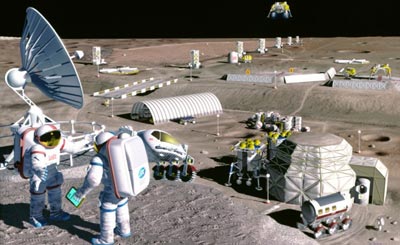
NASA's proposed Moon base: Another misplaced priority

While I give the folks at the National Aeronautics and Space Administration credit for trying, they've got an awful lot of misplaced priorities and show no sign of wising up.

As Greg Esterbrook notes in an excellent Slate piece, it's been obvious for at least a decade that the space shuttle program has outlived its usefulness and the space station program is an enormously expensive joke. But NASA keeps putting the bulk of its funding, which is to say my tax money, into them at the cost of programs that should be priorities.

Don't me wrong, there have been and are some spectacular successes, mostly in the form of interplanetary probes that provide a wealth of valuable scientific information and are celebrated here at Science Saturday.

But notes Esterbrook:
At this point, the shuttle exists almost solely to service the space station, while the station exists almost solely to give the space shuttle a destination to fly to. Two space shuttles have exploded on national television. Yet the program drags on owing to the desire of aerospace contractors, and members of Congress who represent shuttle districts, for launches that cost nearly $1 billion each. The shuttle has operated just once since the Columbia loss in February 2003. It may or may not fly in 2006. Most experiments conducted aboard the space station could be done at far less expense by automated probes. "Life science" research on the astronauts themselves is the sole mission that requires people to be present, but even this boils down to billions of dollars spent for astronauts to take each other's blood pressure. As Gar Smith has written, the space station represents "one of the biggest boondoggles since the Pyramids." Despite the dubious rationales for the shuttle and space station, the proposed fiscal 2007 budget fully funds a new round of waste on these programs—about $8 billion, compared with about $5 billion for space probes, Earth study, and study of the distant universe.
Esterbrook is appropriately exercised about NASA's disdain for programs dealing with the most important planet of all -- Earth -- and says a resetting of priorities is way overdue:
What would constitute rational budget priorities for NASA? The agency's first emphasis should be research about Earth and the sun. That's the sole area in which NASA spending is odds-on to produce immediate returns for taxpayers. Second, NASA should fund more automated probes and satellites to study this solar system and close-by star systems—the parts of space that might have some effect on us. Almost all NASA findings since the moon program have come from automated probes such as Cassini, which a few weeks ago discovered what appears to be a water vent on a moon of Saturn. Most probe projects cost less than a single launch of the space shuttle. Third, the agency should cancel the shuttle program and use the funds to research new propulsion systems that might fundamentally reduce the price of access to space. A fundamental propulsion breakthrough must come before grand visions like a Mars mission. . . .

Fourth, NASA needs a serious program for searching nearby space for asteroids and comets that might strike Earth and figuring out how to deflect any big rock headed this way. Asteroids and comets large enough to cause devastation may strike Earth distressingly often . . . If NASA protected Earth against a strike from space, that might be, let's say, the most significant accomplishment in human history. Yet NASA has only a minor program to search for "near-Earth objects" and no program to figure out what to do about them. Preventing comet strikes would give taxpayers a return on their money, and we can't have that! The new budget request suggests that no one in the agency's hidebound, turf-obsessed upper management wants to think about what NASA can do to actually benefit the public.

Science Saturday II: The Science of Prayer

The collision of science and spirituality is inevitably interesting and the upshot inevitably problematic.

There's a new study out in which a team of researchers asked church congregations to pray for heart surgery patients at six different hospitals and then tracked how well they recovered from surgery compared to patients who weren't prayed for. Neither group did better than the other.

So what does this prove?

Absolutely nothing of consequence, because if prayer works for you -- and I've resorted to it from time to time -- then that's all that matters.

When I prayed for my dying mother, it wasn't to bring her back from the brink of death. It was to ease her pain and suffering no matter what happened. Did my praying make her feel better? I would like to think so, but I do know that it made me feel like I was doing something of consequence at a time when the Fates were in control and not my mother, her children or doctors.

Science Saturday III: The Missing Link?

Scientists say they have found a skull that may be the missing link between Homo erectus and modern man.

The small hominid cranium -- found in two pieces and believed to be between 500,000 and 250,000 years old -- "comes from a very significant period and is very close to the appearance of the anatomically modern human," said Sileshi Semaw, director of the Gona Paleoanthropological Research Project in Ethiopia.

Archaeologists found the early human cranium in Ethiopia's northeastern Afar region. Several stone tools and fossilized animals including two types of pigs, zebras, elephants, antelopes, cats, and rodents also were found at the site.

Homo erectus, which many believe was an ancestor of modern Homo sapiens, is thought to have died out 100,000 to 200,000 years ago.

The cranium dates to a time about which little is known -- the transition from African Homo erectus to modern humans. The fossil record from Africa for this period is sparse and most of the specimens poorly dated.

Find out more here.

Science Saturday IV: Not So Free Willy

When should killer whales not be considered an endangered species?

When they interfere with doing business, according to a lawsuit filed this week against the federal government by farming and industry groups in Washington state who say that the special designation will result in "needless" restrictions on farms near rivers inhabited by salmon, which are the whales' prime food source.

"Farmers could face fines and even imprisonment for the most basic farm practices should such actions allegedly disturb salmon," the lawsuit reads. Environmentalists say that scenario is far-fetched, although harassing a protected species does carry a year in jail.

Orcas are a species of black and white whale featured in the film "Free Willy" and can grow to 30 feet long and weigh 10 tons. Three orca pods, or families, live in western Washington's inland waters from late spring to early fall. They total 89 whales, up from a low of 79 in 2002 but down from historical levels of 140 or more.

CNN has more.