A few visitors to Kiko's House tell me they sometimes have trouble loading the blog. A suggestion: Try switching browsers. If you're using Internet Explorer, try Netscape, or visa versa. Better still, contemplate downloading the marvelous Mozilla Firefox, which you can do for free here.
In any event, apologies for the inconvenience.
Monday, January 30, 2006
The State of the Union Speech: A Plea for Less Mustard and More Meat
 When President George Walker Bush steps up to the Tele-Prompter at the podium in the well of the House of Representatives on Tuesday night to deliver the annual State of the Union speech, he will be greeted by the usual ovation, albeit one more warmly delivered by Republicans than Democrats. He will flash his famous smirk-smile, nod his approval at this outpouring of affection-politeness and wave to the visitor’s gallery with its usual
agglomeration of social bigs and war heroes and widows, and smattering of little folk who believe their lives have been changed for the better because of him.
But when the applause fades and Bush gets down to business, his speech is likely to be a mere echo of the ones that he has given over the past five years, let alone the January 2005 edition.
That was when the swashbuckler from Crawford, Texas, seemed to be flush with political capital from an election that he actually had won outright. He was full of big and bold ideas that would carry him through a second term and deus ex machina into the history books and everlasting greatness despite the wars, pestilence and filibusters littering his path.
By almost any measure, including the fact that second-term presidents historically encounter problems to which they have to give little mind to during their first four years, the last 12 months have been a disaster for Bush, and his speech will be an oblique acknowledgement of that.
A LITTLE PERSPECTIVE, PLEASE
Before I plunge on and then give Country Bumpkin his turn in the post immediately below this one, it seems fair to first ask two interrelated questions:
How much of what has happened in the past year cannot be fairly laid at George Bush’s feet? And how much can? In other words, to what extent is the state of the union as of January 31, 2006, a result of George Bush being president of the United States?
The answer is, um . . . complicated, but not very forgiving of the man who will occupy the Oval Office for three more years.
Bush did not cause Hurricane Katrina, but his administration was responsible for a belated and then hugely bungled response to the disaster that put the lie to the notion that it was adequately preparing the homeland for another event on the scale of 9/11. The president paid dearly in post-Katrina public opinion polls that already showed a majority of Americans were unhappy with the job he was doing and no longer trusted him. His trustworthiness numbers have slipped further still because of the myriad Republican corruption scandals.
Gasoline and home heating oil prices spiked in Katrina's wake, but neither Bush nor any other president bears direct responsibility -- or for that matter can do much about -- a fickle petroleum market that is now increasingly driven by the energy-hungry Chinese and Indian economic behemoths. All that said, the Bush administration's resistance to a broad-based national energy initiative based on renewable resources that might ease dependence on foreign sources of oil and refusal to join in the global warming dialogue has become asinine.
Despite Katrina, the economy has more or less righted itself after several years of stagnation caused only indirectly by Bush administration economic policies
The president can take little credit for this quasi recovery, and while his tax cuts did pour money into the economy, his overall policies have been predicated on borrowing from the future. (Aesop's grasshopper can tell you what will happen when you do that.) And, as one would expect from an administration that pays little more than lip service to the nation's soft underbelly, the gap between rich and poor has accelerated, in part because the tax cuts were hugely weighted to the affluent, while the level of poverty has shot back up after receding through the 1990s.
The Mideast remains the most troubling international hotspot. Bush is not responsible for Iran's bellicosity, Syria's bad behavior in Lebanon or the emergence of Hamas as the governing power in Palestine any more than he caused Ariel Sharon's strokes, but the stability of the region certainly has been further undermined by his war in Iraq.
THE WAR IN IRAQ AND ON TERROR
It used to be axiomatic that domestic affairs would come before international affairs in any sum-up of a presidency, but given the world in which we live today, that notion seems quaint.
Nearly three years after the U.S.-led invasion, it is obvious that the war in Iraq is playing Bush and not the other way around.
Events on the ground are substantially out of the president’s control. This includes the drumbeat of U.S. casualties and flirtation with civil war among the competing Iraqi factions. The administration has walked away from its "Marshall Plan" for rebuilding the war-ravaged country, large swaths of which are controlled by insurgents and violent sectarian militias as the third anniversary of the president's infamously embarrassing "Mission Accomplished" declaration creeps closer. So, there is nothing big and bold that he can say in his speech, certainly not articulating a coherent strategy for getting U.S. troops the hell out.
Bush has repeatedly tried to link Iraq to the 9/11 attacks, but as we move further and further away from that awful day, a connection that was bogus to begin with becomes flimsier still.
Osama bin Laden has conveniently come out of his cave long enough to remind us that he’s still alive and continues to elude U.S. efforts to bring him down that have been compromised by the Iraq war. Bush cannot argue that Al Qaeda has been bested and certainly won't mention that its most active theater of operations is now in U.S. "controlled" Iraq.
As noted, the federal response to Katrina was an eye opener for anyone who believed the Bush administration when it said the country was ready for the Next Big One. Consequently, the president has nothing to point to in the way of inroads in the domestic War on Terror. Even the renewal of his beloved USA Patriot Act is being held hostage by a coalition of Democrats and, gasp! Republicans in the Senate who correctly believe that the House-approved version unncecessarily infringes on civil liberties.
This offers an appropriate segue to the fact that Americans seem to be pretty much evenly divided about the legitimacy of the National Security Agency domestic spying program that Bush secretly approved. That hot-button subject -- which will be aired out in forthcoming congressional hearings and lawsuits -- is not likely to be something that he will dwell on, let alone hype as big and bold. When all is said and done, he acted cowardly and not presidentially.
ON THE HOME FRONT
Nowhere has President Bush squandered more of that precious political capital than on big and bold domestic initiatives.
Several states are refusing to implement provisions of his No Child Left Behind initiative because of the unrealistic educational and financial burdens it forces on them, while nearly half the states have had to intercede in response to the chaotic rollout of his Medicare prescription-drug program initiative. This initiative was to be a key part of the State of the Union speech until it became obvious that in true administration style, the prez and his enablers yet again talked a good game while not bothering to sweat the details. (Memo to George: This also was the recipe for disaster in Iraq, but then no one ever accused you of being a fast learner.)
Then there is the president's big and bold Social Security "reform" initiative, which seems like ancient history now. Thank God. The collapse of the initiative despite a months' long road show across the U.S. to sell it is a reminder that the American people are not always gullible. Bush, of course, claimed that his reforms would preserve the program for future generations. Americans understood that it would do no such thing and the harder the president pushed the initiative the more people were repelled by it. In the end, it was an unmitigated disaster.
(This is a good example of the administration's penchant for intentionally misleading or outright lying when there is no reason to do so. Social Security does indeed need mid-course corrections, but Bush and his handlers took the alarmist and utterly false course of claiming that it was on the verge of bankruptcy and that the nation's elderly would be left destitute.)
There is a double (triple?) whammy for Bush here: The anticipated successes of the Social Security reform initiative and Medicare drug program initiative were going to open the door to yet another big and bold second-term initiative -- health-care savings plans. But he finds himself confronted by a public deeply concerned about benefits cuts of any kind after his attempted Social Security grab, a Treasury badly depleted because of profligate spending, and a federal deficit growing by leaps and bounds. So it's likely that big and bold initiative will be toned down.
SLOPPY SECONDS
What then is there left for a president with historically low poll numbers to speechify on?
He is pretty much left with two oldies as he plods into his sixth year in office and looming mid-term elections that could deplete if not erase the Republican majority in Congress if the Democrats show signs of having a pulse. (It is pretty much a given that Democrats will pick up statehouses; the White House's dealings with the states have been characterized by an imperious inflexibility that has not gone unnoticed in the hinterlands.)
Here is what Bush will stress in his State of the Union speech:
* The need to vigorously prosecute the War on Terror and its implicit flipside, the weakness of Democrats on all things national defense.
The only area in which the president maintains an edge in the polls over Democrats is terrorism. The Dems are indeed weak and seem to be hopelessly befuddled at a time when the Republican juggernaut is vulnerable. But prattling on about the War on Terror has taken on a Chicken Little quality absent any tangible successes to point to and, yes, the dangerous complacency that comes with the fact that there has not been an attack on the homeland since 9/11. However, merely stating that fortunate circumstance -- which Bush will do while whistling past the grave yard -- doesn't pay the rent.
And remember, Katrina was a hurricane, not a hijacked airliner, toxic chemical release or "dirty" nuclear bomb.
* Making tax cuts permanent.
This is indeed a big and bold initiative given the precarious state of the Treasury, but it is easier said than done because the administration's addiction to overspending and embrace of pork barrel politics is undermining it. The budget deficit is staggering and growing. The war in Iraq is an enormous drain, as will be rebuilding New Orleans. The mood of a public that used to be a pushover for tax cuts has changed, and once what had been a slam dunk will be a hard sell -- perhapy an impossibly hard sell.
THE BIG SUM-UP
The success of a presidency need not be measured by big ideas and bold ideas. In fact, that concept is contrary to traditional Republican conservatism. George Bush has nevertheless staked his success on the big and bold, although he can be forgiven for overreaching to an extent.
However, with the exception of helping stoke the flames of democracy in the Mideast, those big and bold initiatives all have foundered, or in the case of the Iraq war had profoundly grotesque results.
The initiatives have all foundered not because Bush is a visionary before or beyond his time, but as a consequence of a power-hungry presidency famously isolated from reality, cloaked in secrecy, driven by political expediency, blind to corruption and hubristically confident that only it has the right answer no matter the question. No wonder there is such a feeling of pessimism in the U.S. today. For all of that Bush cannot be forgiven.
I'll say it again: The success of a presidency need not be measured by big and bold initiatives. It is likely that the speech that Bush delivers will be reflective of an administration oft bitten-now shy, and chary of going boldly anywhere. You should understand that this is not because of a concern that thinking big and bold and again not delivering would cause harm to the republic, but because of the harm it would do to his political standing.
So we can expect less, perhaps a lot less on Tuesday night. In this case, less mustard and more meat would be a good thing, as well as an opportunity for Bush to turn around a very troubled presidency before he makes an even bigger mess of things.
The State of the Union Speech: A Counterpoint
From Country Bumpkin:
As American readers of this blog prepare to cluster around their TV sets Tuesday evening to hear George Bush deliver his sixth State of the Union address, they should remember to keep the event in some sort of proportion. Here in New Zealand a week or two ago, the co-leader of the New Zealand Greens, Jeanette Fitzsimons, delivered her State of the Planet address. (Roughly, we'll have to give up everything we enjoy, and even if we do we're doomed; doomed, I say!)
So there! Beat that!
Seen from our corner at the bottom of the Pacific, the hostility generated by President Bush, and what that says about the State of the Union, is more than a little perplexing. (That said, there is here -- and has long been -- a great deal of left-wing hostility to the US, and more lately towards Bush, but it pales beside the vituperative and unremitting hatred of President and Country by the American Far Left.)
Because Americans and New Zealanders live in two of the freest countries in the world, we can say what we think and there is no compulsion to think what we say. The results are not always pretty, and this might be a good moment to try and balance up the argument, with thanks to Shaun for the opening.
(1.) It became an overnight cliché on 9/12/2001 to say that the world would never be the same again. Despite that, enormous forces have been at work in the West which might have been designed to ensure that it, the world, wouldn't change, and chief among these has been the workings of diplomacy.
(2.) For example, as long as Arafat was alive, nothing changed in the Israel-Palestine conflict except that the Israelis built a wall and were condemned for it from pillar to post. Deaths from terrorism, however went down to almost nothing. (And now, although new forces are lately at play in that conflict, radical solutions might well be more acceptable than once they were.)
(3.) Newly inaugurated President George W. Bush, in the aftermath of 9/11, began to see the responsibilities of the United States and the Presidency in new ways. Forgive me for the Readers Digest-style paraphrase, but his vision reduces itself to an acknowledgment that the old geopolitical notion that "stability", as the aim of International diplomacy, was not working. Something fresh was needed, and of that the most important recognition was that democratic societies -- however imperfectly constituted -- stand the best chance of granting personal freedom and economic success to their citizens.
(4.) To his everlasting credit, Bush has clung grimly to the execution of this broad policy, and has withstood the bombardment of hatred and criticism which has gone with it. It is entirely unreasonable for his enemies (and his supporters) to expect that results would be immediate, or that new problems would not turn up.
The initiative in Iraq will almost certainly succeed, no matter what the domestic pressures are on the president; Afghanistan is slowly rising to its feet (and I know this from people who have served there); Iran remains a threat to be dealt with.
(5.) Bush is always criticised for his lack of oratorical power. Winston Churchill he ain't, but it is a grave mistake to assume that because a man speaks in simple language, he must therefore be a simpleton. Look no further than the CBS News interview with Bob Schieffer last Friday for evidence of this. Amid the umming and aahing portrayed by the transcript (and that's what transcripts do, because people talk like that) Bush succeeded very well in articulating his thinking.
(6.) Bush may not be president long enough to see all the results of the US's new geopolitics in office.
But this New Zealand commentator, whose information sources are reading and seeing mainstream media, Internet news, and weblog commentaries, thinks that Dubya is a remarkable fellow.
Not least because he's had the balls to go this distance with his policies and beliefs. Compare him, in that respect, to LBJ.
As American readers of this blog prepare to cluster around their TV sets Tuesday evening to hear George Bush deliver his sixth State of the Union address, they should remember to keep the event in some sort of proportion. Here in New Zealand a week or two ago, the co-leader of the New Zealand Greens, Jeanette Fitzsimons, delivered her State of the Planet address. (Roughly, we'll have to give up everything we enjoy, and even if we do we're doomed; doomed, I say!)
So there! Beat that!
Seen from our corner at the bottom of the Pacific, the hostility generated by President Bush, and what that says about the State of the Union, is more than a little perplexing. (That said, there is here -- and has long been -- a great deal of left-wing hostility to the US, and more lately towards Bush, but it pales beside the vituperative and unremitting hatred of President and Country by the American Far Left.)
Because Americans and New Zealanders live in two of the freest countries in the world, we can say what we think and there is no compulsion to think what we say. The results are not always pretty, and this might be a good moment to try and balance up the argument, with thanks to Shaun for the opening.
(1.) It became an overnight cliché on 9/12/2001 to say that the world would never be the same again. Despite that, enormous forces have been at work in the West which might have been designed to ensure that it, the world, wouldn't change, and chief among these has been the workings of diplomacy.
(2.) For example, as long as Arafat was alive, nothing changed in the Israel-Palestine conflict except that the Israelis built a wall and were condemned for it from pillar to post. Deaths from terrorism, however went down to almost nothing. (And now, although new forces are lately at play in that conflict, radical solutions might well be more acceptable than once they were.)
(3.) Newly inaugurated President George W. Bush, in the aftermath of 9/11, began to see the responsibilities of the United States and the Presidency in new ways. Forgive me for the Readers Digest-style paraphrase, but his vision reduces itself to an acknowledgment that the old geopolitical notion that "stability", as the aim of International diplomacy, was not working. Something fresh was needed, and of that the most important recognition was that democratic societies -- however imperfectly constituted -- stand the best chance of granting personal freedom and economic success to their citizens.
(4.) To his everlasting credit, Bush has clung grimly to the execution of this broad policy, and has withstood the bombardment of hatred and criticism which has gone with it. It is entirely unreasonable for his enemies (and his supporters) to expect that results would be immediate, or that new problems would not turn up.
The initiative in Iraq will almost certainly succeed, no matter what the domestic pressures are on the president; Afghanistan is slowly rising to its feet (and I know this from people who have served there); Iran remains a threat to be dealt with.
(5.) Bush is always criticised for his lack of oratorical power. Winston Churchill he ain't, but it is a grave mistake to assume that because a man speaks in simple language, he must therefore be a simpleton. Look no further than the CBS News interview with Bob Schieffer last Friday for evidence of this. Amid the umming and aahing portrayed by the transcript (and that's what transcripts do, because people talk like that) Bush succeeded very well in articulating his thinking.
(6.) Bush may not be president long enough to see all the results of the US's new geopolitics in office.
But this New Zealand commentator, whose information sources are reading and seeing mainstream media, Internet news, and weblog commentaries, thinks that Dubya is a remarkable fellow.
Not least because he's had the balls to go this distance with his policies and beliefs. Compare him, in that respect, to LBJ.
Sunday, January 29, 2006
Fare Una Promissa Fantastico
Italian Prime Minister Silvio Berlusconi is famous for ambitious promises, but may have outdone himself this weekend in promising not to have sex before the April 9 general election.
Berlusconi fashions himself as a hunk even at age 69, and in fact looks years younger because of plastic surgery and a hair transplant. He is quick to crack jokes with sexual inneuendos and is frequently at odds with feminists.
His wife did not comment on what she thought of the promise.
Caveat Emptor, Y'All
 I knew that eBay was going to be a gigantic success way back in the 1990s when a friend, confronted with the problem of disposing of her deceased and very tall mother's collection of size 13 shoes, put them up for bid on the online marketplace. They were quickly gobbled up by a grateful crossdresser from Kansas City.
These days the shoe is on the other foot, so to speak, and eBay is under attack for selling knockoffs. Details from the New York Times here.
EBay's defense that it has no obligation to investigate counterfeit claims is unconvincing. Tiffany & Co. sure isn't buying, and has sued eBay for selling Tiffany fakes.
Meanwhile, I know from my own expertise in one area -- late 1960s and early 1970s psychedelic rock posters from San Francisco music venues -- that the buyer had indeed better beware, especially because the market in posters, always awash with fakes, is red hot right now and prices have tripled and quadrupled to stratospheric levels.
I cruise eBay looking for good buys from time to time and regularly find posters that seem too good to be true. Which means they almost certainly are.
Run Hillary Run
Andrew Sullivan discusses Hillary Rodham Clinton's strategy for securing the Democratic presidential nomination in his weekly Sunday Times of London column. I suggest that you read the whole thing, but here's the nut:
Running to the left of President George W Bush and to the right of him as well is not a feat most politicians are able to pull off. But Hillary has no alternative. And in that lies her dilemma. She has too liberal a past (and reputation) to be the Democratic right’s favoured candidate; and she’s become far too conservative in the Senate to win over the Democratic left.
Michael Yon: Blogger Extraordinaire
I'm anti Iraq war but pro military. That is to say that I have come to utterly and absolutely oppose that fool's mission but support the troops who are, after all, only trying to do their job.
That brings me to Michael Yon, one of the best bloggers to emerge from the war. Here's an excerpt from an Associated Press profile on him:
That brings me to Michael Yon, one of the best bloggers to emerge from the war. Here's an excerpt from an Associated Press profile on him:
After getting himself embedded as a freelance journalist with troops last year, he used his Internet blog to report on the car bombs, firefights and dead soldiers. But he also wrote descriptively about acts of compassion and heroism, small triumphs in the country's crawl toward democracy and the gritty inner workings of the military machine.
Yon's dispatches have been extolled by loyal readers as gutsy and honest reporting by a guy who's not afraid to get his hands dirty. He has been interviewed and his blog quoted by major newspapers and TV news networks, and he has drawn comparisons to Ernie Pyle, the renowned World War II correspondent who shared the trenches with fighting soldiers.
(Hat tip to Glenn Reynolds at Instapundit.)
Hey, Ayman, What's That Buzzing Sound?
 One of the more salutatory developments in the War on Terror has been the coming of age of the drone-fired missile.
The Los Angeles Times reports today that despite protests from other countries, the U.S. is expanding a top-secret program to kill suspected terrorists targeted by the pilotless drones as it pursues an increasingly decentralized Al Qaeda.
Although little is known about the targeted-killing program, U.S. officials confirm that there have been at least 19 occasions since 9/11 on which CIA- and Pentagon-operated Predator drones successfully fired Hellfire missiles on terrorist suspects, including 10 in Iraq in one month last year.
Most recently, a CIA-controlled Predator fired missiless at compound in a remote Pakistani village on Jan. 13 in a failed attempt to assassinate Osama bin Laden's No. 1 man, Ayman Zawahiri. Upwards of 18 civilians, many of them women and children, were killed, but U.S. intelligence offcials say the attack also took out four or five Al Qaeda operatives.
Critics of the program dispute its legality under U.S. and international law, and while they have a point, this is an instance where bending if not breaking the law for a greater good -- to eliminate exceedingly evil and dangerous men who want to kill you and I -- can be justified.
The Predator is 27 feet long, has a 49-foot wingspan and color surveillance cameras. It can hover over a target for many hours and usually is operated from command consoles at CIA headquarters in Langley, Va., and the Pentagon.
And reminiscent of the German V-1 rocket of World War II, it makes a distinctive buzzling sound.
The Palestinian Authority Money Trail
The question of how the perennially profligate Palestinian Authority is going to keep its head above water with Hamas now at the helm looms large in light of the fact that foreign donors are chary of bankrolling the radical group and some already have been withholding money because of repeatedly missed fiscal targets.
(Hamas for its part wants it both ways: It will welcome continuing aid for the PA but won't recognize Israel.)
The Council of Foreign Relations says this about the sources of the PA's funding:
The Belmont Club, citing American Future via the Times of London, offers this breakdown:
A total of $1.06 billion, of which a whopping $368 million comes from the U.S.
Other donors include theEU ($338 million), Britain ($43 million), Italy ($40 million), Sweden ($32 million), Germany ($27 million) and Spain ($17 million).
The Belmont Club's Wretchard offers this perspective:
(Hamas for its part wants it both ways: It will welcome continuing aid for the PA but won't recognize Israel.)
The Council of Foreign Relations says this about the sources of the PA's funding:
A combination of overseas assistance and tax collection. . . . taxes — from businesses in the territories, as well as a customs tax collected by Israel and then paid to the Palestinians — account for about 40 percent of the PA budget. Donations from abroad make up the rest. The PA has run into budget trouble lately, running a massive deficit and sparking the wrath of European donors by adding thousands of people to the security service instead of cutting costs. Experts say Fatah padded its payroll with young militants to win their votes ahead of the polls, and expect the PA will be unable to pay all their salaries after the elections. Since November 2005, the European Union has withheld $42 million in aid payments to the PA as punishment for missed fiscal targets.Also interesting is who is providing overseas assistance and how much.
The Belmont Club, citing American Future via the Times of London, offers this breakdown:
A total of $1.06 billion, of which a whopping $368 million comes from the U.S.
Other donors include theEU ($338 million), Britain ($43 million), Italy ($40 million), Sweden ($32 million), Germany ($27 million) and Spain ($17 million).
The Belmont Club's Wretchard offers this perspective:
The relationship between the West and the Palestinian proto-state has been unnatural in that it paid or supplied most of the services that the Palestinian state ought to have provided in the first place. This not only contributed to corruption but relieved the Palestinian political parties of the burden of good governance. It was never necessary to collect garbage or build roads and the political parties were free, like teenagers supported by indulgent parents, to leave their rooms dirty while they raised hell.
Now some will argue that the Palestinian Authority was in no position to do this due to Israeli occupation. But now that they've got some territory and a government that excuse will be thin.
More is expected of America than to "do business" with the PA in the same way it does with other countries. It will not be enough to desist from invasion and to observe international usages. What is expected is to keep paying their bills.
I think the implicit expectation will be to keep the money -- a.k.a. the peace process -- flowing to Hamas. Failure to do this will be described as "punishing the Palestinians" for exercising their democratic rights. But where is it written that one country must underwrite another?
Meanwhile, the New York Times reports today that many Israelis see a silver lining of a sort in the Hamas vistory.
Saturday, January 28, 2006
Bob and George Go One on One
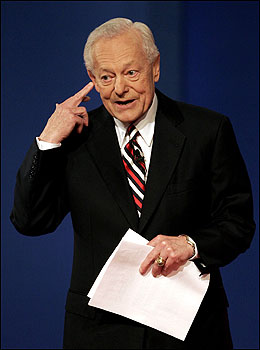 Television network news has taken a beating in recent years and increasingly resembles a vestigal organ. It used to be good for something, but I'm not sure what.
There are all the 24/7 cable competitors, the Internet and now the proliferation of blogs, many of which draw impressively large numbers of visitors disaffected with what they see and hear -- or pissed off because of what they don't see and hear and think they should -- on the traditional ABC, CBS and NBC evening news programs.
I have to admit that I also give those shows little notice these days. If I'm ensconsed at Kiko's House when the evening news programs come on, I'll surf from network to network and then on to the BBC World News to see what the top stories are, all the while listening to Internet radio or a music CD.
So when the CBS Evening News headlined an exclusive Bob Schieffer interview with President Bush last night, I rolled my eyes. Could this really be the most important story out there? I surfed on to the Beeb and then "Seinfeld" and "The Simpsons" reruns while listening to Mozart, who had a pretty big birthday yesterday, the Big Two Five Oh, to be exact.
But I felt a tinge of guilt this morning. What if Schieffer, one of the few surviving members of the old network TV news guard and a fine and emminently fair journalist (as opposed to what the Brits call a "news reader") had asked some good questions? What if Bush had said some good things?
So off I went to find and read the transcriptof the interview. I urge you to do so, too. You can certainly reach your own conclusions, but for me what the president had to say (when not fumbling for the right words, which he did repeatedly) goes a long way to explaining why his popularity has steadily eroded and why the problems that America faces at home and abroad seem so intractible for the want, in large part, of better leadership.
* * * *
The interview also is a nice lead-in to posts by yours truly and Country Bumpkin on the president's forthcoming State of the Union speech. Look for them.
Friday, January 27, 2006
King George: Lying About the Little Things
 As I've said before, one of the most confounding -- and insidious -- things about President Bush and his aides is that they even lie about things that aren't worth lying about.
The most recent example is photographs of King George and disgraced super lobbyist Jack Abramoff.
First the White House said that no such photos existed. When this was found to be untrue, a spokesman said that the president could not recall meeting Abramoff. The president reinforced this whopper himself at a press conference yesterday when he stated that "I don't know him."
Let's get this straight:
Bush, who has the politician's knack of remembering faces and places, doesn't know the most influential lobbyist of his tenure, a man who was thisclose to Karl Rove, the president's chief aide and mentor, a man so wired that he could arrange meetings (for a hefty fee) between clients and the president, a man so integral to the Republican Party money machine that his fingerprints were all over it.
Wouldn't it have been easier, as well as made political sense, for Bush to have said that he of course knew Abramoff. Who in Washington didn't? But he certainly doesn't condone his conduct.
Apparently not.
There's also a rear-guard action here worthy of the infamous 18 1/2 minute gap in a key Nixon White House tape subpoenaed by Watergate investigators:
A company called Reflections Photography was the official photographer for the 2004 Bush-Cheney campaign and 2005 inauguration. It is the photo agency of choice at White House events such as those where Bush and Abramoff were photographed.
But in the last two days sections of its Web site where Bush-Abramoff photos resided have just upped and disappeared.
Now isn't that a coincidence!
When Josh Marshall of Talking Points Memo inquired about the disappearing act, a Reflections Photography staffer obviously not in the destroy-and-deny loop helpfully suggested that he could purchase a Bush-Abramoff photo from a backup CD. But when the staffer tried to access the photo, she was audibly surprised when she found that it had been deleted from the CD.
And so the coincidences -- and lies about things not worth lying about -- pile up.
Exorcising the Ghosts of 1968
Most people who were liberals in 1968 still are. Liberals. In 1968.
It is with those provocative words that economist and self-described former liberal Arnold King begins an essay at TCS Daily. It's well worth reading, especially if you consider yourself to have been a liberal then and still are.
(Hat tip to Glenn Reynolds at Instapundit.)
Quote du Jour
From a New York Times editorial today on the Hamas victory in Palestinian elections:
Hamas has a choice between governing and terror. Is the party more interested in making sure that the electricity and water stay on, that Palestinian boys and girls make it to school, and that these battered people finally get a state of their own? Or is it more interested in continuing its campaign to destroy Israel? If Hamas chooses the latter, it's more than likely that it will not be around for long, and rightly so.
Exploding Space Shuttle Challenger Myths
 The 20th anniversary of the space shuttle Challenger disaster is upon us, and what better time to er . . . explode some of the myths that have grown up around the horrific event, which took the lives of the seven astronauts on board.
James Oberg, an NBC News space analyst and former Mission Control operator at NASA's Johnson Space Center, does just that in this interesting piece.
Here are the myths:
* A nation watched as the tragedy unfolded.
* The Challenger exploded.
* The crew died instantly.
* Dangerous booster flaws were the result of meddling.
* An environmental ban led to a weaker pressure sealant.
* Political pressure forced the launch after repeated delays.
* The disaster was an unavoidable price for progress.
Thursday, January 26, 2006
George Galloway Voted Off the Island
 British MP George Galloway, best known for his over-the-top opposition to U.K. involvement in the Iraq war and only slightly less for his ability to make enemies and behave eccentrically, was booted last night from a popular reality television show.
Reports The Guardian:
George Galloway tonight became the fourth person to be evicted from the Celebrity Big Brother house as he admitted he had failed in his aims during almost two weeks of reality TV.
The Respect [Party] MP attracted 64.7% of public vote after being nominated alongside fake celebrity Chantelle Houghton and US basketball star Dennis Rodman.
He showed little emotion as his eviction was announced by presenter Davina McCall. He hugged, kissed and shook hands with the other housemates before making for the door.
As he emerged from the house, a smiling Galloway was met with boos and cheers from the crowd who gathered for tonight's double eviction.
Donned in a smart black suit and shirt, the 51-year-old MP for Bethnal Green and Bow constituency told McCall: 'That was my last election and I lost it so hey. I thought I could get on with almost everybody, Tony Blair excepted, but I certainly could not', he said.
'I thought I could bring people together in a common cause and I failed. I thought I could live without the news and I could not. So I did learn things about myself. I also learnt some personal things', he added, though he declined to elaborate.
The Hamas Victory and What It Means
 You probably known that the Islamic radical group Hamas captured a large majority of seats in Palestinian legislative elections on Wednesday.
The upset win raises a host of questions, all of them troubling:
* What will the victory mean for the Mideast peace process?
An enormous setback followed by further turmoil.
The old saying that you need to be careful what you wish for is certainly in play. Did Hamas really want to take over sole the administration of the creakily corrupt Palestinian Authority?
Nope. It had assumed, as had most observers, that the incumbent Fatah party would prevail, or there would be a coalition government.
(Note that Mahmous Abbas, more or less moderate president of the Palestinian Authority and Fatah's leader, was not affected by the vote per se, but his desire to restart peace negotiations with Israel is now stillborn with Hamas at the wheel. Note further that Hamas conceivably could force him out at some future time.)
* Will Hamas now renounce its virulently anti-Israel ways and stop its year's-long suicide bombing campaign?
It's very difficult to see that happening.
Palestinians knew damned well who they were voting for, and the results were as much a renunciation of Fatah, which is widely viewed on the street as out of touch and corrupt, as a victory for Hamas, which has patiently organized at the community level for years and built up an enormous reservoir of good will through its considerable charity work.
* What will it mean for the U.S.?
While the Palestinians have to be judged by the decision they made in the voting booth, it's difficult to imagine the U.S. susidizing a terrorist group, as it has the Fatah-led Palestinian Authority, even if it is now coming to power through legitimate means.
Or is it more complicated than that? We shall see.
* What will it mean for Israel?
Coming as it does on the heels of the Sharon medical crisis and installation of an interim government, the omens are bad. As noted, the idea of a resumption of peace talks suddenly seems to be DOA.
Furthermore, the Hamas victory plays into the hands of an Israeli lunatic fringe that would like nothing more than a full-scale war. That makes the omens downright scary.
Josh Marshall at Talking Points Memo found a wee (I dare say microscopic) silver lining:
[P]olitical participation can force a hard form of accountability. If there is a major constituency for Hamas in the territories -- which certainly there is -- perhaps to have them in the government, on the line for dealing with nuts and bolts problems of administration, on the line for delivering a better life for the Palestinians as opposed to just peddling the heroin of violence, has some advantages over having them on the outside as a paramilitary force with a de facto veto over whatever the Fatah-based government chooses to do.
Yes, yes, there's a lot of grasping for straws here. But as long as the structures of democratic government remain secure and intact -- a big 'if' -- participation in government tends to force a measure of pragmatism and accomodation.
As conundrums go, the unexpected Hamas victory is a lulu for President "Liberty Is Spreading Across the Middle East" Bush. His response this morning was to do what he and his administration reflexively resort to when confronted by uncomfy realities -- spin like hell.
Bush only obliquely acknowledged Hamas's radical underpinnings and violent history, but spoke at length about people demanding honest government. Said the prez:
The people want services. They want to be able to raise their children in an environment in which they can get a decent education and they can find health care. And so the elections should open the eyes of the old guard there in the Palestinian territories.That hit uncomfortably close to home -- as in the US of A, where finding good schools and affortable health care are ongoing struggles. And presumably will be issues when citizens of the oldest democracy in the world themselves go to the polls later this year to have their say about another old guard -- the one in Washington.
Finally, MSNBC blogger Eric Alterman reflects my sentiments exactly:
If George W. Bush has had no positive virtues whatever as president, he at least has taught us that things can always get worse. So too, have the Palestinian elections. It would be hard to invent a worse result than a victory for the vicious, corrupt group of murderous gangsters and hucksters who run Fatah . . . if you think that overstated—but a victory for Hamas is just that.
The ironies abound, all of them painful.
First off, it was the Israelis themselves who helped get Hamas off the ground as a potential alternative to Arafat. Second, they have shown themselves to be its most significant political supporter with their refusal to deal with the far more moderate and westernized Fatah, undercutting its ability to show anything for its public face of moderation and therefore pushing people into the arms of the relatively corruption-free, socially responsible Hamas. Third, while the reasons that the Palestinians support Hamas may have little to do with its professed desire to wipe Israel off the map—again—they genuinely provide real services and do not terrorize the population for their own material gain as does Fatah—the net result will be to give the Israeli hardliners the opportunity to further immiserate the Palestinian masses, putting off the day, even further into the future, when these almost infinitely abused people will ever be able to live their public lives with some dignity and, perhaps prosperity.
It’s encouraging to see a genuinely democratic election in the Arab world, yes. But look what you get. This is one of the too-many-to-count fallacies in the insanely counterproductive neocon strategy in the Middle East, which I’m sure will only get worse. In the meantime, the short-term winner of this election is Bibi Netanyahu, which is bad news for all humankind.
Iran Update: Enrich and Defuse?
Since Kiko's House is obsessing on Iran this week, it's worth noting that there has been a possibly positive development: Russia has proposed to defuse the confrontation between Iran and the West over its worrisome nuclear program by establishing a joint venture to enrich uranium in Russia.
The devil is in the details of course, and among the unanswered questions is whether the agreement would be merely commercial, which is to say financial, or whether it also would be scientific. Russia had previously offered to produce uranium for a nuclear power plant it is building in Iran on condition that the spent fuel be returned to Russia for reprocessing.
The Devil's Dictionary VI
 Here's a sixth entry in an ongoing series from Ambrose Bierce’s “The Devil’s Dictionary.”
Bierce (1842-1914) was a brilliant but underappreciated American author and journalist who had a long and tumultuous releationship with press baron William Randolph Hearst, and was a misanthrope possibly without peer.
DAWN
Noun. The time when men of reason go to bed. Certain old men prefer to rise at about that time, taking a cold bath and a long walk with an empty stomach, and otherwise mortifying the flesh. They then point with pride to these practices as the cause of their sturdy health and ripe years; the truth being that they are hearty and old, not because of their habits, but in spite of them. The reason we find only robust persons doing this thing is that it has killed all the others who have tried it.
Wednesday, January 25, 2006
Quote du Jour
Daniel Benjamin and Steven Simon in a New York Times op-ed today that argues the U.S. is not effectively countering Osama bin Laden and other jihadist blatherings:
Despite so much evidence that the jihadists are winning sympathy, America has provided no counter-story to their narrative. Rather, the president has repeatedly objected to the notion that the Iraq war is having a radicalizing effect by arguing that America was attacked before we ever stepped foot in Iraq.
This, of course, is a non sequitur - douse a guttering fire in gasoline and you will get a bigger fire. A movement that was staggering after the Taliban was toppled has come back with a vengeance. Realistically, we cannot deploy a counter-narrative - one that emphasizes that we are a benign superpower - so long as our troops are in Iraq. That will make it difficult to separate moderates from extremists, as an ideological struggle requires. We must focus more on developing that story and getting out of Iraq with the least damage to our interests and less on the phony truce offers of a guileful enemy.
Sex Sells
A group of anonymous buyers has purchased sex.com, long one of the most coveted Web sites because of its obviously catchy name, for a cool $12 million.
The new owners said in the statement that they plan to transform Sex.com into "the market-leading adult entertainment destination," which they said would include "adult dating opportunities," sex and relationship advice, erotica, video-on-demand and live chat.
The sale ranks as one of the most expensive Web domain name transfers ever and far outpaces the $7.5 million paid for business.com in 1999 at the peak of the dotcom boom.
'Feature Creep' and the American Automobile
Robert Farago, the editor of the Truth About Cars website, is one of our favorite writers because (1.) the folks at Kiko's House like cars, (2.) most automotive writing is boringly conventional, but he writes outside the box, sometimes way outside the box, and (3.) he usually writes with the pedal to the metal.
In this editorial, Farago muses about the downside of freedom of choice when it comes to automobile gadgetry. An excerpt:
In this editorial, Farago muses about the downside of freedom of choice when it comes to automobile gadgetry. An excerpt:
In 1817, Marie-Henri Beyle toured the Uffizi museum. Lost in a maze of galleries, the French novelist was paralyzed by indecision. His heart raced. His breathing was shallow and labored. His mind was completely disoriented. He couldn't move. Beyle eventually wrote about his experience under his pen name, Stendahl. In 1979, Italian psychiatrist Graziella Megherini coined the phrase "Stendahl Syndrome" for people paralyzed by excessive choice. It’s a concept bedeviling supermarkets, web pages and . . . carmakers.
For example, BMW's M5 is considered the ultimate sports sedan. And yet the uber-5er faces a bewildering range of operational decisions: three suspension, shifting and e-traction levels; two horsepower options and eleven gearbox modes. While a hard-core cadre of enthusiasts embrace the Bimmer’s programmability, most newbies sit in the M5's driver’s seat and . . . freeze. After overcoming the initial shock, they rely on one or two factory settings-- or walk away thank Gott in Himmel they own something a lot less complicated.
The M5’s complexity reflects automakers’ overly literal interpretation of America’s favorite shibboleth: freedom of choice. Carmakers clearly believe that the more their products cater to each owner’s personal preferences, the better. You only have to count the number of motors underneath a [Mercedes] S-Class’ seat-- or tally-up the number of ways it can massage, heat or cool its occupant’s hindquarters-- to see the philosophy in action. And it’s not just the luxury playas kissing ass. Even a humble Hyundai Elantra offers eight-way adjustable seats. This sort of multi-variable “feature creep” is spreading through the automotive landscape like electronic kudzu.
In the Court of King George
The Bush adminsitration's power grab and concomitant use of "executive privilege" grows more mindblowing -- and frightening -- by the day.
Documents released yesterday by a Senate committee show that the White House was told in the hours before Hurricane Katrina hit New Orleans that the city probably would be inundated with floodwater, forcing the long-term relocation of hundreds of thousands of people. This puts the lie to the Bush administration fiction that it was surprised as anyone when the levees were breached and . . . hundreds of thousands of people had to be relocated.
The administration, citing the confidentiality of executive branch communications, said today that it would not turn over certain Katrina documents or make senior officials available for sworn testimony before two Congressional committees investigating the response to the storm.
Not surprisingly, but nevertheless appalling.
(Hat tip to Kevin Drum at Washington Monthly.)
Documents released yesterday by a Senate committee show that the White House was told in the hours before Hurricane Katrina hit New Orleans that the city probably would be inundated with floodwater, forcing the long-term relocation of hundreds of thousands of people. This puts the lie to the Bush administration fiction that it was surprised as anyone when the levees were breached and . . . hundreds of thousands of people had to be relocated.
The administration, citing the confidentiality of executive branch communications, said today that it would not turn over certain Katrina documents or make senior officials available for sworn testimony before two Congressional committees investigating the response to the storm.
Not surprisingly, but nevertheless appalling.
(Hat tip to Kevin Drum at Washington Monthly.)
The (Very) Thin Green Line
The Army is stretched so thin by frequent troop rotations to Iraq and Afghanistan that it could snap unless relief comes soon, according to a Pentagon study.
Andrew Krepinevich, a retired Army officer who wrote the report, concluded that the Army cannot sustain the pace of troop deployments to Iraq long enough to break the back of the insurgency. He also suggested that the Pentagon's decision to begin reducing the number of troops in Iraq later this year was driven in part by a realization that the Army was overextended.
As evidence, Krepinevich points to the Army's 2005 recruiting slump — missing its recruiting goal for the first time since 1999 — and its decision to offer much bigger enlistment bonuses and other incentives.
"You really begin to wonder just how much stress and strain there is on the Army, how much longer it can continue," he said in an interview with the Associated Press. He added that the Army is still a highly effective fighting force and is implementing a plan that will expand the number of combat brigades available for rotations to Iraq and Afghanistan.
Krepinevich wrote that the Army is "in a race against time" to adjust to the demands of war "or risk 'breaking' the force in the form of a catastrophic decline" in recruitment and re-enlistment.Col. Lewis Boone, spokesman for Army Forces Command, which is responsible for providing troops to war commanders, pissed on the report and said his organization has been able to fulfill every request for troops that it has received from field commanders.
The report mirrors comments made by U.S. Rep. John Murtha, who said on December 1 that the war in Iraq has left the U.S. Army "broken, worn out" and "living hand-to-mouth."
Murtha, the Pennsylvania Democrat, 37-year Marine Corps career officer and Vietnam veteran, touched off a political firestorm in November when he called for an immediate troop withdrawal from Iraq.
* * * *
Meanwhile, Noah Shachtman over at defensetech.org has been keeping up with the inevitable leaks of the Pentagon's Quadrennial Defense Review, and he's troubled by what he sees:
My quick, subject-to-instant-revision first impression: Rumsfeld & Co. are focusing more on China than they are on Osama.
. . . Terrorist-type threats will get some new attention. But the Defense Department isn’t about to optimize for that threat, the way it did for the Soviet Union. Big money will continue to be spent on fighter jets designed to duel with the Soviets and destroyers designed for large-scale ground assaults. Grunts on the ground won’t get much more than they do now. The war on terror may be “long.” But, apparently, it’s not important enough to make really big shifts.
Google: Proprietary Trumps Principle
 It wasn't too long ago that I was dissing Microsoft for capitulating to Chinese censors and removing the U.S.-based blog of a dissident Chinese journalist.
Well, Google (whose wonderful Blogger software supports Kiko's House and a zillion other blogs) has announced that it's launching some of its services in China, which will mean subjecting itself to what it quaintly terms "self censorship."
Google is the last large U.S. Internet company to go into China. KRT News says that
The delay reflects months of internal wrangling over how to balance business interests against its distaste at having to comply with China's restrictive speech policies.It seems like that distaste wasn't as distasteful as losing out on the world's largest emerging market.
Ahem.
* * * *
Speaking of Microsoft, the software giant said today that it would disclose and license parts of the Windows source code in an effort to quiet growing criticism from regulators. The New York Times has the story.
Iran Prez Misses Apparent Assassination Try
Gateway Pundit seems to be all over an apparent assassination attempt against Irani President Ahmadinejad. Here's a link.
I say "apparent" because it does seem peculiar that so-called Arab dissidents are running around Iraq unchecked and Ahmadinejad gets tipped that they're gunning for him. It all seems a bit too pat.
I say "apparent" because it does seem peculiar that so-called Arab dissidents are running around Iraq unchecked and Ahmadinejad gets tipped that they're gunning for him. It all seems a bit too pat.
Iran and Syria: The Terror Twins
Michael Ledeen has a prescient post at National Review Online on the inextricable and inextricably dangerous ties between Iran and Lebanon. An excerpt:
In short, the Assad family's grip on Syria is weakening, and this is welcome news indeed, both for the long-suffering Syrian people and for us. The Iranians are obviously desperate to keep Assad in power, and Hezbollah armed to the teeth. Should things go the other way, Iran would lose its principal ally in the war against us in Iraq. As is their wont, the Iranians have been paying others to do much of their dirtiest work, and they have awarded Assad tens of millions of dollars' worth of oil, as well as cash subsidies, to cover the costs of recruiting, training and transporting young jihadis, who move from Syria into the Iraqi battle space (and, according to Jane's, a serious publication, the Iranians have also sent some of their WMDs to Assad for safekeeping). That deadly flow has been considerably reduced in recent months, thanks to an extended campaign waged by U.S. and Iraqi forces in Anbar Province, and further along the Iraq/Syria border. The Syrians have accordingly sent radical Islamists into Lebanon, perhaps to link up with Hezbollah in a new jihad against Israel.(Hat tip to Country Bumpkin, who not coincidentally posted a well-worth-reading comment on my Iraq-Iran commentary yesterday.)
What Is It? Trans Fat
 In the third of a semi-regular series posts called "What Is It?", Kiko's House tells you everything you need to know about trans fat.
Trans fat is much in the news these days, at least in the U.S., because of its unhealthfulness. Foodmakers have rushed to drop trans fat as an ingredient and note in big, bold print on the labels of their cookies, pies and potato chips that they are “Trans Fat Free!” or have “Zero Trans Fats!”
So what the heck is trans fat, why is it harmful and are foodmakers being honest in saying that their products have been purged of it?
Trans fat exists at naturally low levels in some food, but is usually the product of a process called hydrogenation in which liquid oils are mixed with hydrogen gas to produce a substitute for butter fat and beef tallow that had a nice plasticity for baking.
Hydrogenation was the rage for many years because it was easy and cheap and the resulting trans fat was believed to be healthier than animal fats. But times change and trans fat is now considered to be the worst of the fats and far worse for the old ticker than saturated fat.
That said, we eat much more saturated fat than trans fat, so getting rid of trans fat does not guarantee a life free of heart problems. Meanwhile, under U.S. food labeling guidelines that took effect on January 1, any food with less than 0.5 grams of trans fat per serving can declare its content as having zero grams. So be aware, especially if you have gluttonous urges, that those little bits of trans fat can still add up.
One more question: When foodmakers got rid of trans fat, they had to substitute it with something else, right?
Right.
Among the substitutes are palm oil, coconut oil and stearic acid, but there is no agreement among nutritionists as to whether these are really heart helpful. Furthermore, some foodmakers have swapped out trans fat for more saturated fat, so some products actually have ended up with more total fat than they had before.
Then there are all those other bugaboos like calories, refined starch and that old standby – sugar. So being trans fat free doesn’t get you off the hook. Not by a long shot.
Sources: U.S. Food and Drug Administration, Los Angeles Times.
Tuesday, January 24, 2006
More Cowbell, Please!
The drum solo, long a rock concert staple, usually was an excuse to hit the snack bar or lavatory even if the drummer was hot stuff. The trick was making it back into the arena before his bandmates returned to the stage and the main event resumed.
Alas (or not), the drum solo has joined Keith Moon, John Bonham and other late, lamented drummers in the Great Rock 'n' Roll Beyond, according to Dan Neil in a witty Los Angeles Times article.
Alas (or not), the drum solo has joined Keith Moon, John Bonham and other late, lamented drummers in the Great Rock 'n' Roll Beyond, according to Dan Neil in a witty Los Angeles Times article.
What a Wicked Web They Weave
 A funny thing happened on the way to the Bush administration’s justification of the National Security Agency’s domestic spying program: It became even more obvious that it was not only not necessary, but could not have survived the usual checks and balances built into what I will quaintly refer to as the American political system.
 It was Gen. Michael V. Hayden, the former NSA chief who is now deputy director of national intelligence, who spilled the beans amidst a big administration blitz led by King George himself to sell the once secret spying program in the run-up to mid-term elections.
Hayden stressed that the program “is not a drift net over
Or let's assume for the moment that Hayden is not being entirely up front and the NSA program was outside FISA's scope. Why not simply go to Congress, which has given the White House virtually all it wants to fight the War on Terror, and ask it to amend FISA or pass a new law.
Because, methinks, Hayden is indeed not being candid -- and the whole bunch of 'em are hiding something big.
Why Iran Bears Little Resemblance To Iraq (And Boy Does the White House Know It)

Given the Bush administration’s oft-stated justifications for invading Iraq, it should stand to reason that the U.S. should invade Iran.
Let’s make that case by reviewing those justifications and overlay them on the situation in Iran. When one does so, the result is not a pretty picture, but explains why the kind of saber rattling the U.S. did regarding Iraq in the months before the 2003 invasion has been substantially absent when it comes to Iran:
Iran Has WMDs and Is a Threat to the Region